In the range of this venerable house, the oldest still active in the Rhône Valley, only Rhône appellation wines. With emphasis on the northern crus, Côte Rôtie and Condrieu in particular, which are its origins
Maison Vidal Fleury, based in the small commune of Tupin-et-Semons very near Ampuis, was founded in 1781 by Joseph Vidal from his vineyard in Côte Rôtie. Which makes it the oldest Rhône house still active. The anecdote says that Joseph Vidal bought his first plot of vines from the lord of Ampuis; it also says that a certain Thomas Jefferson, US ambassador to France and future president of that nascent nation, stopped there in 1787, barely two years before the Revolution. But Vidal Fleury survived this turbulent period and even phylloxera at the end of the 19th century thanks to the dowry of a Miss Fleury, wife of Gustave Vidal, which made it possible to replant the vineyard…
Today, Vidal Fleury, while keeping its autonomy, prospers next to another great house of the Rhône Valley, Maison Guigal. The history of these two “institutions” of the wine world is intimately linked: in 1924, Étienne Guigal was recruited at Vidal-Fleury as cellar master before founding his own négoce 30 years later. With the success we know. More than 60 years later (in 1985), when Vidal Fleury was for sale for lack of a successor within the family, it was quite naturally to Marcel Guigal – Étienne’s son – that the Vidal-Fleury heirs turned, and an agreement was reached between the two families with intertwined destinies.
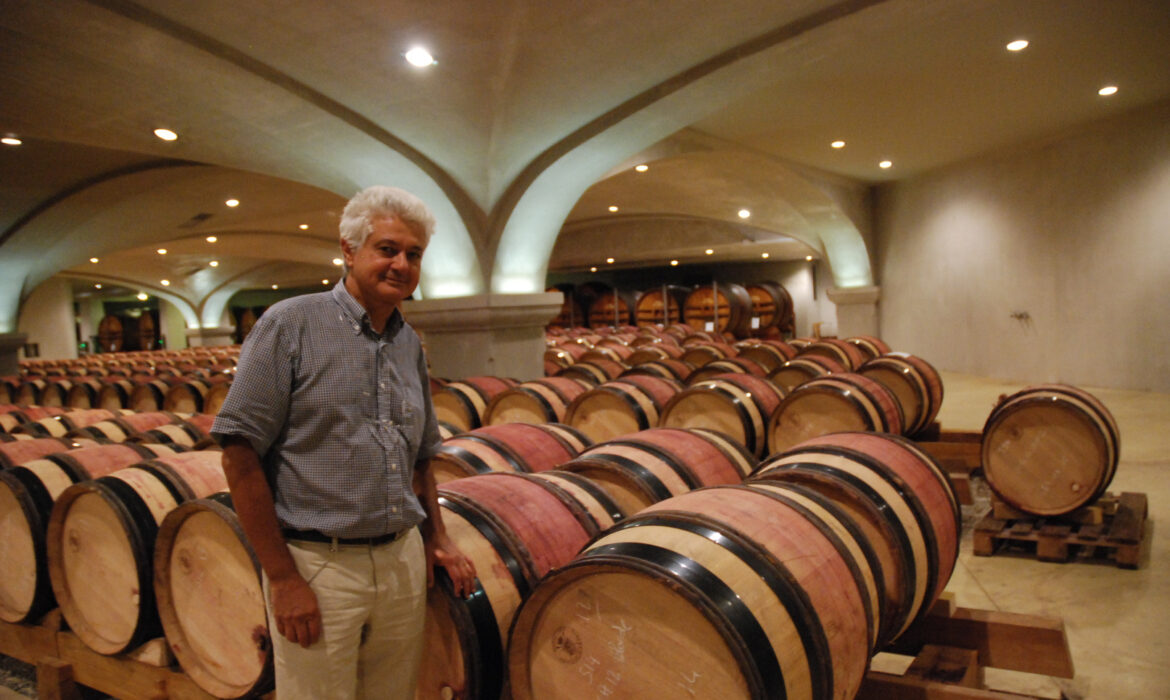
“A story fairly easy to sum up, all in all,” stresses Guy Sarton du Jonchay, who has run the House since 2008. Called in to energise the company, the director-oenologist of Vidal Fleury, a graduate in agronomy and oenology, has a particular professional profile that took him from the Médoc to Australia via Argentina where he made wine at 2,000 m altitude. “I am half Argentine,” he adds. “And it is not a criticism of New World wines, but if I came back to France, it is to make appellation wines, terroir wines.”
And where could he have better expressed his talents than at Vidal Fleury, which has produced the finest Rhône appellations since almost the beginning of its history? For if until 1920 the House worked only with its own grapes in the northern Rhône Valley, it took the step to become a producer-négociant in the time of Joseph Vidal-Fleury, by establishing itself in the southern part where it owns no vines.
The palette of wines has thus widened, with 19 appellations today: Côte-Rôtie, Condrieu, Saint-Joseph, Cornas, Hermitage and Crozes-Hermitage in the north; and Châteauneuf-du-Pape, Gigondas, Vacqueyras, Tavel, Cairanne in the south. Not forgetting Côtes-du-Rhône Villages, Ventoux and even a sweet wine, Muscat de Beaumes-de-Venise. That is one million bottles a year, 70% sold for export. “It is our strategic axis, with one priority, the United States, which is our first market.” The Thomas Jefferson effect, no doubt…
In 2008, coinciding with the arrival of the new director-oenologist, Vidal-Fleury invested nearly €20 M in its new cellars. A modern 9,000 m2 building, Napa Valley-style winery in California, planted at the foot of the terraces of the Côte Rôtie vineyard – right between the Blonde and the Brune – which remains the spearhead (100,000 bottles) of the House. “For us it is about optimising ageing – sometimes up to 4 years – conditioning and bottle ageing of the wines. Because even if the building is modern, we have a fairly purist approach to the notion of appellation d’origine contrôlée.” Which means that still today, true to its roots, Maison Vidal Fleury claims for each of its wines the signature of terroir.
Jean Calabrese
Key facts
CEO: Marcel Guigal
Managing director: Guy Sarton du Jonchay
Address: 48 route de Lyon – 68420 Tupin-et-Semons / +33 4 74 56 10 18 / contact@vidal-fleury.com
Commercial brands: Vidal-Fleury; Brune et Blonde de Vidal-Fleury; La Chatillonne