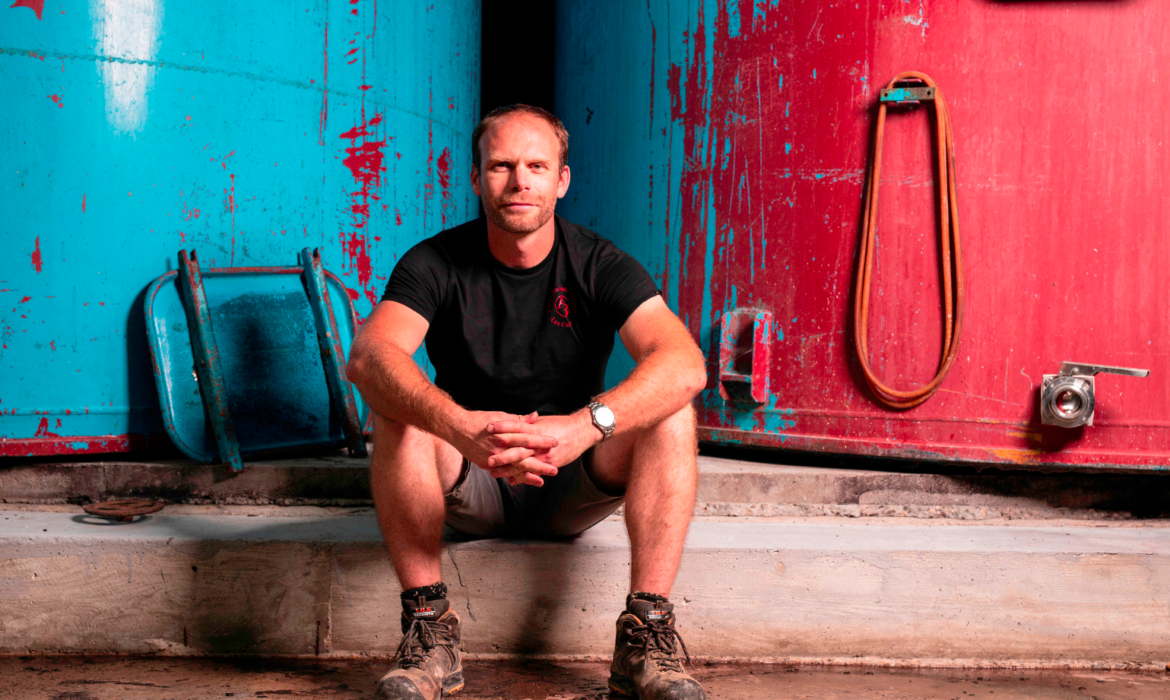
Following in the footsteps of his grandfather Lucien and his father André, who died recently, Fabrice Brunel, the winegrower of Domaine André Brunel – Les Cailloux in Châteauneuf-du-Pape, is not short of ideas for developing his négoce business. All while keeping in mind the standards that made his estate wines a success.
Fabrice Brunel arrived at the family farm in 2013 after working for about ten years in a consulting firm specialising in production management and logistics. This probably explains why he has such an unselfconscious view of his job as winegrower-négociant. He has just launched a programme to install solar panels over four hectares of vines in Travaillan near Orange and is preparing to produce gin from his own grape marc. He has also built a new 3,000-hectolitre winery in his Châteauneuf-du-Pape cellar, equipped with a brand-new tasting room: there had been none until now at Domaine André Brunel – Les Cailloux.
But what occupies him most is developing his négoce activity in the Côtes-du-Rhône, Côtes-du-Rhône Villages and Châteauneuf-du-Pape appellations… in fact the same appellations as the estate wines. “Only the labels – and the contents of the bottles, of course – change,” says Fabrice. “Domaine André Brunel on one side and Vins André Brunel on the other. It’s subtle but effective.”
Fabrice Brunel also produces Vins de France. Such as “Le Tracteur de Brunel”, marketed since 2017 (40,000 bottles a year), a blend of Grenache (40%) and Merlot (40%) from the Domaine, and Syrah bought in négoce from partner growers. This wine, aged a year in tank and sold at €6, is a great hit with customers who like to drink a red at aperitif time.
THREE SOURCES OF SUPPLY
“Le Tracteur de Brunel” perfectly illustrates how the activities of the estate and the négoce house intertwine. From the start, with the supply of juice coming from 3 different sources:
– First, the estate, split into three main zones: Châteauneuf-du-Pape (21 ha, two of them white), Travaillan-Uchaux and Saint-Geniès-de-Comolas in the Gard (more than 60 ha of Côtes du Rhône and IGP): “We had a somewhat ageing vineyard that needed replanting,” explains Fabrice Brunel. “Which we did with the same grape varieties but in different proportions: more Grenache and less Syrah. Today, the négoce Grenache comes from our own vines and we buy Syrah from outside because we have little in our vines.”
– Then the partner growers with whom the House has worked for years and who sell the Brunel family all or a large part of their harvest. “It adds up quickly,” says Fabrice. “Three or four growers with estates of about fifty hectares quickly make a few hundred or a few thousand hl.”
– Finally, the traditional bulk sellers, who allow the blends to be completed as needed.
NEW: BUYING GRAPES
In the end, the négoce house’s production – officially registered under the surprising name La Cerise – represents the equivalent of 800,000 to 900,000 bottles (against 300,000 for the estate). This production should increase since, from last year, Fabrice Brunel’s company began buying grapes. “As we enlarged the cellar, we can bring in more.” Grapes from the estate’s own vines first, which, once replanting is finished, will be at full production capacity in 2025: 95 ha in total, 30 ha more than today. And grapes from new partner growers: 15 ha around Vaison-la-Romaine and a little less in Travaillan. All in Côtes du Rhône.
This additional source of supply allows the négociant to control an extra step in the making of his cuvées: the ageing and storage of the wine, the owner taking care only of the harvest. “By vinifying ourselves, we get the wine profile we want.” In 2021, the first year of this new system, everything went well.
CONSOLIDATING THE BASICS FIRST
Going to look for a few hectolitres in Vacqueyras or another Rhône Valley appellation is not on the agenda: “There is no demand from our customers. Besides, we already have enough to do with our 90 hectares of vines and our négoce in generic Côtes du Rhône.” Fabrice Brunel’s goal is rather to finish the replanting so as to supply a larger share of his own négoce, which would let him buy less juice from outside.
“But I would like to develop négoce Châteauneuf-du-Pape because we make little of it and there is a real possibility there. Because in our range, I would say that between the Côtes du Rhône Villages and the estate Châteauneuf-du-Pape, there is, in price terms, a gap in which a négoce Châteauneuf-du-Pape would find its place.”
Still with the idea of progressing on his wine range, Fabrice is considering making more rosé, for now sold only in bulk. But there is no question of launching into bottles without first finding the markets. For the Châteauneuf winegrower-négociant, although fond of innovation, knows he must consolidate his foundations before moving forward. Always keeping anchored in him “the desire to make wine that pleases the person who drinks it, without being financially out of reach”. A mission he has set himself and in which his négoce house actively takes part.
Jean Calabrese
////////////////////////////////////////////////////////////////////////////////////////////
KEY FACTS
The estate: 110 hectares of land, 95 of them planted; all will be in production by 2025. It was Lucien Brunel, Fabrice’s grandfather, who created the Les Cailloux brand in 1954. Originally 21 ha of Châteauneuf-du-Pape, the estate grew through successive purchases in Côtes du Rhône and Vin de Pays de Vaucluse.
The négoce house: now chaired by Fabrice Brunel, it was officially registered in 2005 by André Brunel (who died early this year), who named it “La Cerise”. But it is better known as “Les Vins André Brunel”.
6 cuvées x 2: two Châteauneuf-du-Pape (one white and one red), one Côtes du Rhône Villages and 3 generic Côtes du Rhône for the estate. The same for the négoce house + one Vin de France.
Distribution networks: different for the two entities, with one thing in common: 80% of sales are export. In the Nordic countries (Norway, Sweden, Denmark), the United States, the United Kingdom and Japan. Given the international context and its uncertainties, Fabrice Brunel wants to shift part of his exports back to France and a little more towards private customers.
Contact: 6 chemin du Bois de la Ville, Châteauneuf-du-Pape.
Tel: +33 4 90 83 72 62 / Email: fabrice.brunel@domaine-andre-brunel.fr