The historic Rhône Valley house that symbolises the famous Côte-Rôtie on its own wants to be present in every market, playing on its institutional yet reassuring image with consumers and juggling tradition and modernity…
Founded in 1781, Vidal-Fleury can be proud of being the oldest Rhône house still in business and of having received, in 1787, a visit from Thomas Jefferson, third President of the United States, then living in France as ambassador of the new American nation. A pioneer in international trade, Monsieur Vidal-Fleury quickly became a true ambassador for all the crus of the Rhône Valley and a major player in the revival of the Côte-Rôtie vineyard. For 40 years now, the House has belonged to the famous Guigal family, whose founder, Etienne Guigal, began his wine career at Maison Vidal-Fleury between 1922 and 1946.
Today, Antoine Dupré runs Vidal-Fleury. Arriving in November 2020, the new managing director seems to bring together in his new role all the skills he has acquired over his remarkable and enriching career. He has moved around quite a bit, from the Entre-Deux-Mers in Gironde to South Africa, then Beaune in Burgundy with Bouchard Aîné et Fils, Maison Gabriel Meffre in Gigondas, and Les Grands Chais de France where he bought Southern Hemisphere wines for the Group, and finally back to the Rhône Valley, the north this time, at Vidal-Fleury.
“It’s true that I’ve knocked around quite a bit,” says the man whose vision changed after his experience as a winemaker in South Africa. There, once the harvest is over and the wines are made and ageing, the technical oenologists become ambassadors for their estate, which was not necessarily the case in France at the time. “That is what made me want to know the international markets better.” To his oenologist’s hat (he holds a DNO from the University of Bordeaux), he therefore added a second by earning a specialised master’s degree in international wine and spirits trade at ESC Dijon.
On arriving at Vidal-Fleury, the new MD had set himself many objectives, stating on his arrival: “We are going to be on every front.” These included changing the profile of the wines on the technical side and being on every front on the commercial side, insisting that there are no small markets. What has happened since?
EXPORT FIRST
“Maison Vidal-Fleury historically developed on export markets, which represent about 70% of its business. The geopolitical and economic context is therefore very important for us.” United States, Northern Europe, Great Britain, Japan, Canada, China… but not, or hardly, Russia, where Antoine Dupré was eager to prospect. Alas! The pandemic and the war in Ukraine froze his ardour… “Fortunately we have a solid base in the other markets, in more than 50 different countries, built on historic relationships, which allow us to keep growing despite the current problems. We have the strength of a historic, unique, strong and reassuring brand.”
In France, the priority targets are restaurants (notably the “pretty” brasseries), wine shops and certain wine fairs, as well as specialised websites. A tasting cellar, open all week, located within the Vidal-Fleury winery itself, also welcomes enthusiasts to an exceptional place in the heart of the Côte-Rôtie vineyard, ideally situated at the foot of the slope for a cellar visit and tasting of the Rhône Valley crus.
A WIDE RANGE OF RHÔNE VALLEY CRUS
Vidal-Fleury, which employs ten people (excluding seasonal staff), now puts nearly 1.2 million bottles on the market, about 70% of them crus (85% red, 10% white, the rest rosé).
It offers one of the most complete ranges in the Rhône Valley: Côte-Rôtie, Condrieu, Saint-Joseph, Cornas, Hermitage, Saint-Péray and Crozes-Hermitage in the north; Châteauneuf-du-Pape, Gigondas, Vacqueyras, Tavel, Cairanne, Côtes du Rhône Villages, Côtes du Rhône, Ventoux and Muscat de Beaumes-de-Venise in the south. “A homogeneous range of appellations with level, consistent price points that can meet many requests,” says the MD, who points out that Vidal-Fleury partners with some fifty selected growers.
TRADITION AND MODERNITY
When he arrived in Tupin-et-Semons, the small commune in the northern Rhône where Vidal-Fleury is based, Antoine Dupré had to acknowledge that, despite the quality of the House’s wines, some consumer remarks regularly came up about Côtes du Rhône being “rustic, dusty”. “Today, our consumers want fruit-driven wines that are more drinkable when young. That is what we set about doing, by playing on extractions, changing the containers (barrels, demi-muids, foudres, wood toasting) and the length of ageing,” he sums up.
But you must not mix everything up. Even if the base of the Vidal-Fleury pyramid is made up of Côtes du Rhône and Ventoux, which account for the largest volumes, the top of the pyramid is magnified by our wines from the Côte-Rôtie vineyard: “It’s our DNA.” Starting with that priceless and confidential jewel that made Vidal-Fleury’s reputation: the Côte-Rôtie La Chatillonne, planted on a 0.8-hectare plot, of which the House keeps a certain quantity of bottles from each vintage to offer later to our privileged customers! Antoine Dupré adds: “An extremely rare thing given the tension in Côte-Rôtie!” Not forgetting the other emblematic Vidal-Fleury cuvée: “Brune et Blonde de Vidal-Fleury”, a blend of wines from grapes grown in both the north and south of the appellation: “this cuvée represents the expression of different Côte-Rôtie terroirs in a given vintage.” The best proof of the know-how of Antoine Dupré and his team, who bring modernity to Vidal-Fleury while respecting tradition, which is essential at Vidal-Fleury.
Jean Calabrese
Vidal-Fleury – 48 route de Lyon, Tupin et Semons (69420)
Tel: +33 4 74 56 10 18 / www.vidal-fleury.com
/////////////////////////////////////////////////////////////////////////////////////////////////
A restyled label for the new organic range
When Antoine Dupré arrived three and a half years ago, one of the first things on his mind was reworking the labels. A few video calls and meetings later with all his importers, the shared conclusion was: “Above all, do not touch the labels!” This label represents “the DNA of Vidal-Fleury, classic, traditional and easily recognisable in all markets”. He admits that changing it would have been a significant mistake: “I simply refreshed it with a new paper, a dedicated shade, a few touches of gold, revived colours.” It should be introduced during 2024.
That did not stop him from working on a new look for Vidal-Fleury’s new range, a Côtes du Rhône from organic farming. While keeping the capsule and the collar, essential landmarks for consumers, he placed an anchor at the centre of this label to recall Vidal-Fleury’s anchoring in Côte-Rôtie while paying tribute to the Rhône, which allowed this historic house to grow and be a pioneer in the wine trade.
//////////////////////////////////////////////////////////////////////////////////////////////////////////
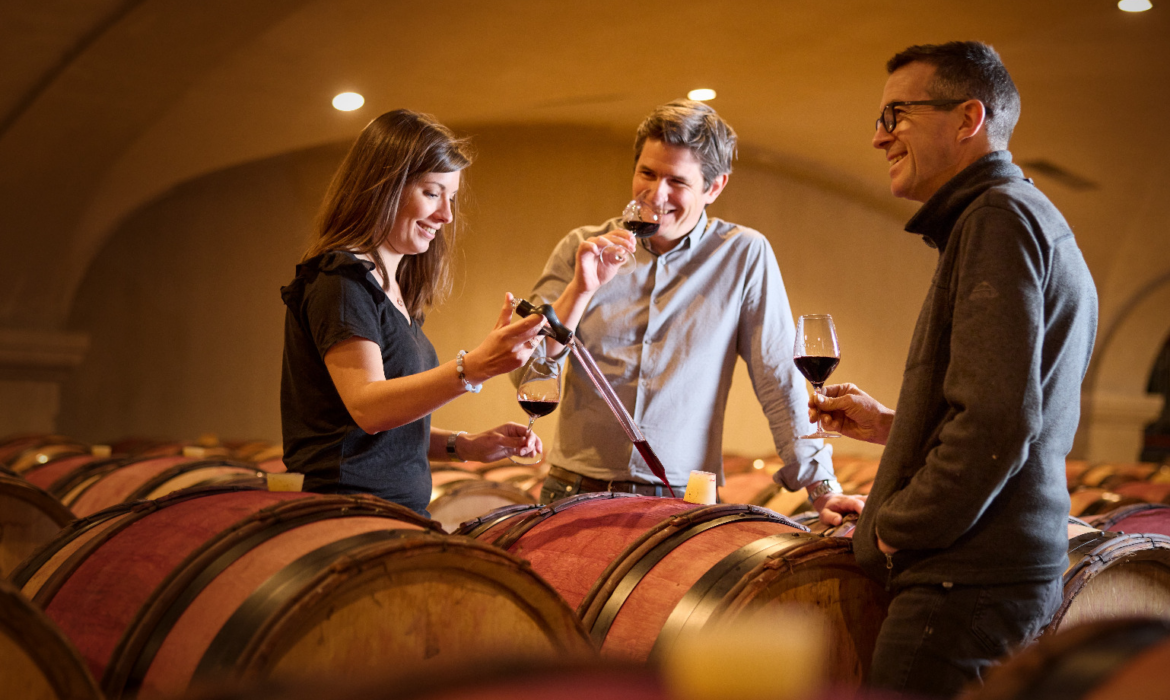
- Team photo:
Left: Bérangère Andrieu, Oenologist / Cellar master
Right: Marc Ambroise, Production / Maintenance manager
Middle: Antoine Dupré, MD / Oenologist