After playing a driving and major role in the renovation of the vineyard in the 1980s and 1990s, the Union des Vignerons Ardéchois, which today markets 85% of Ardèche wines, is playing the biodiversity card. It is thus in tune with a département favoured by French and foreign tourists for its natural side.
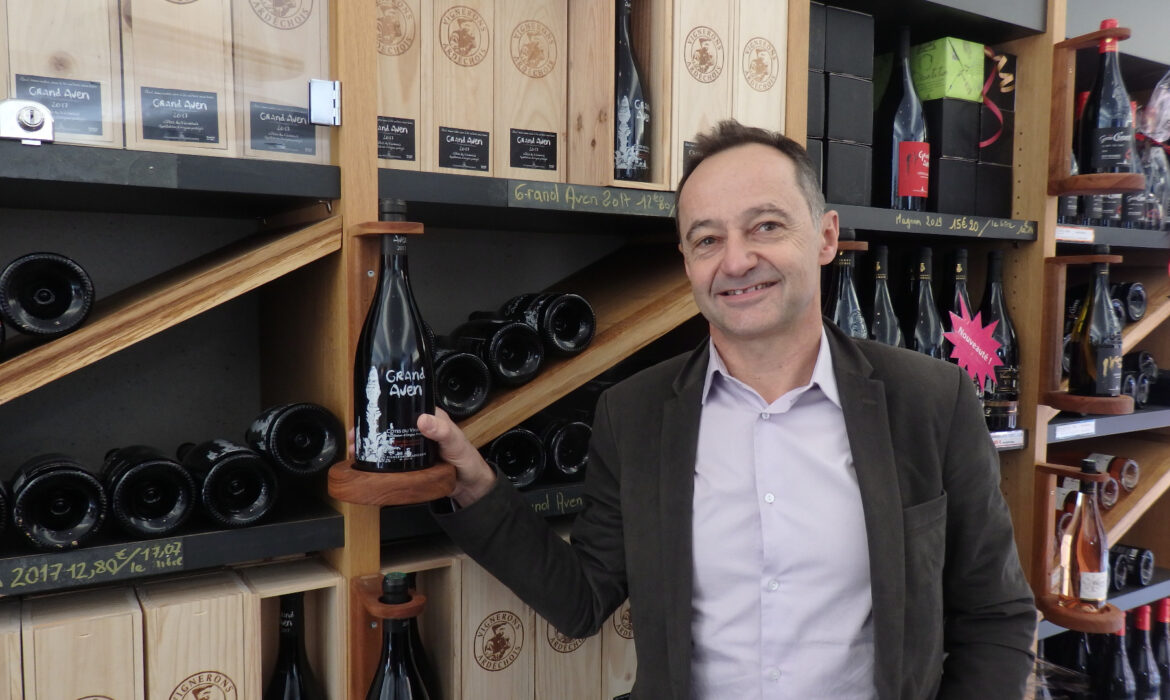
In the wine world, the Union des Vignerons Ardéchois is an almost unique case. This grouping of cooperative cellars (14), all on full delivery, works on a simple scheme: the cellars make the wine according to each one’s specificities in terms of grape varieties and terroir; the Union’s oenology department defines the winemaking process for each cuvée, handles storage, bottling and marketing. The Union, which buys the wine from its members, thus plays the role of parent house of the cooperative structure. Philippe Dry has been its managing director since July 2015, alongside president François Guigon. He succeeded Denis Roume, who spent almost 30 years in the post.
“The Vignerons Ardéchois is a fairly lasting structure,” he stresses, “which works in continuity. I am in fact only the 3rd director, Guy Boyer having been the first.” A Burgundian by origin, who worked in food-industry marketing until 1992, he then entered the wine world. First in a Beaujolais house belonging to the Boisset group, then in Chablis, before running the famous Ribeauvillé cellar in Alsace. And finally the Ardèche, which he knew and enjoyed as a tourist.
A mosaic of grape varieties and terroirs
From Aubenas to the Gard and from the Rhône Valley to the Cévennes, this is a wine territory of more than 6,000 ha distinguished by great diversity of terroirs and grape varieties. “There is enormous potential in this southern Ardèche, where you find almost the map of France’s great vineyards,” says an enthusiastic Philippe Dry. Over 50 years, the Ardèche has indeed replanted almost all the great French grape varieties. Rhône varieties are of course found there (notably Viognier, Syrah, Grenache), which represent the core of the Vignerons Ardéchois’ business and on which interesting expressions of terroir are found. But also Bordeaux varieties (Cabernet, Merlot, even Sauvignon) and Burgundian varieties (Chardonnay and Pinot Noir on more than 500 hectares).
To explain this myriad of grape varieties (more than twenty), one must go back to the first partnership signed in 1979 with Maison Latour, then looking for sources of supply for its white wines. For the winegrowers it was a real realisation of the quality of their terroirs. Since then, this groundwork in partnership with houses from outside the region has continued with, among others, Georges Duboeuf (Beaujolais) on Gamays and Michel Laroche (Chablis) on Pinots Noirs. “These partnerships reinforced our desire to replant noble grape varieties suited to our terroirs. Always betting on quality rather than yields.” Yields very rarely exceed 50 hl/ha even though the Ardèche territory is 90% an IGP region. “But we really work the Ardèche as an appellation conducive to quality wines.”
Among them is Chatus Monnaie d’Or, named after a native grape variety already mentioned by Olivier de Serres in his writings in the 15th century, which survived phylloxera and was thought lost forever. It is productive, colourful, very resistant and late-ripening, with quite a bit of acidity. Found somewhat by chance on sandstone terraces in the Cévennes (in the village of Vernon there is even a vine dating from 1883), the winegrowers have pampered it and replanted about fifty hectares. “It is a variety that is becoming more and more interesting with regard to global warming,” adds the director of the Vignerons Ardéchois, “and we are going to replant it.”
Ardèche par nature: biodiversity, a priority
Launched in 2016, the “Ardèche par nature” brand formalises the process of an environmental approach started by a few winegrowers at a time when organic was in its infancy and the HVE standard did not exist. Which is easily explained, according to Philippe Dry: “We have always been in a naturally preserved territory and environment with extraordinary biodiversity. And our customers expect that from us.” Gradually, winegrowers and cellars joined the approach, and the Union des Vignerons Ardéchois teamed up with various bodies committed to nature protection: installing beehives and nesting boxes, creating hedges… everything helps maintain biodiversity!
Today, two thirds of the vineyard are HVE-labelled (more than 4,000 ha). Next year, bar a few plots, it will be all of it, including the roughly 500 ha already converted to organic. “Ardèche par nature” fits this philosophy: a registered brand with specific specifications which, beyond reducing inputs and treatments, include elements on biodiversity management. A motivating charter for winegrowers who, with the Vignerons Ardéchois, have a safety net. For such practices lead to lower yields and greater risks, and it is the parent structure that bears them. Ardèche par nature, fully organic from the 2022 vintage, is reserved for traditional channels. A 2nd brand, Ardèche par passion, from the same terroirs, is intended for supermarkets.
Jean Calabrese
THE STRENGTH OF WINE TOURISM
In addition to the head office in Ruoms, which houses the packaging, storage and shipping centre, the Vignerons Ardéchois created Néovinum in 2013, a 1,500 m² space devoted to discovering the vine and wine, adjoining the sales tasting room. They have two other reception sites:
– the Aven d’Orgnac, an underground cellar (−50 metres) in which 15,000 bottles are aged and where numerous wine-tourism events are held, underground tastings in particular, which highlight the ageing potential of these wines, mainly from Coteaux du Vivarais.
– the Terra Noé estate (25 ha), in organic conversion, which is somewhat the experimental ground for the winegrowers’ new practices. It also houses the reception structure of the company “Ardèche Vignobles” created in 2018: a participatory company of a cooperative nature with more than 800 members. The money collected (more than €2 million to date) has made it possible to buy 60 ha of vines made available to young winegrowers setting up.
KEY FACTS
14: the number of cooperatives belonging to the Union des Vignerons Ardéchois (representing about a thousand farms).
6,000: the vineyard area in ha, scattered across a multitude of plots.
300,000: average annual production in hl (40% rosé, 40% red, 20% white), almost 85% of it IGP, the rest split between Côtes du Rhône and Côtes du Rhône Villages at the Bourg-Saint-Andéol cellar (around 15,000 hl, about 50% organic) and Coteaux du Vivarais for 6 to 7,000 hl.
2,000: the number of wine shops in France partnering with the Vignerons Ardéchois, which also export 20% of their production to 40 countries.
52: turnover in € million. For a production of 10 million bottles and 3.5 million Bag-in-Box®, which represent 2/3 of the volume and 50% of the value.
www.vignerons-ardechois.com