
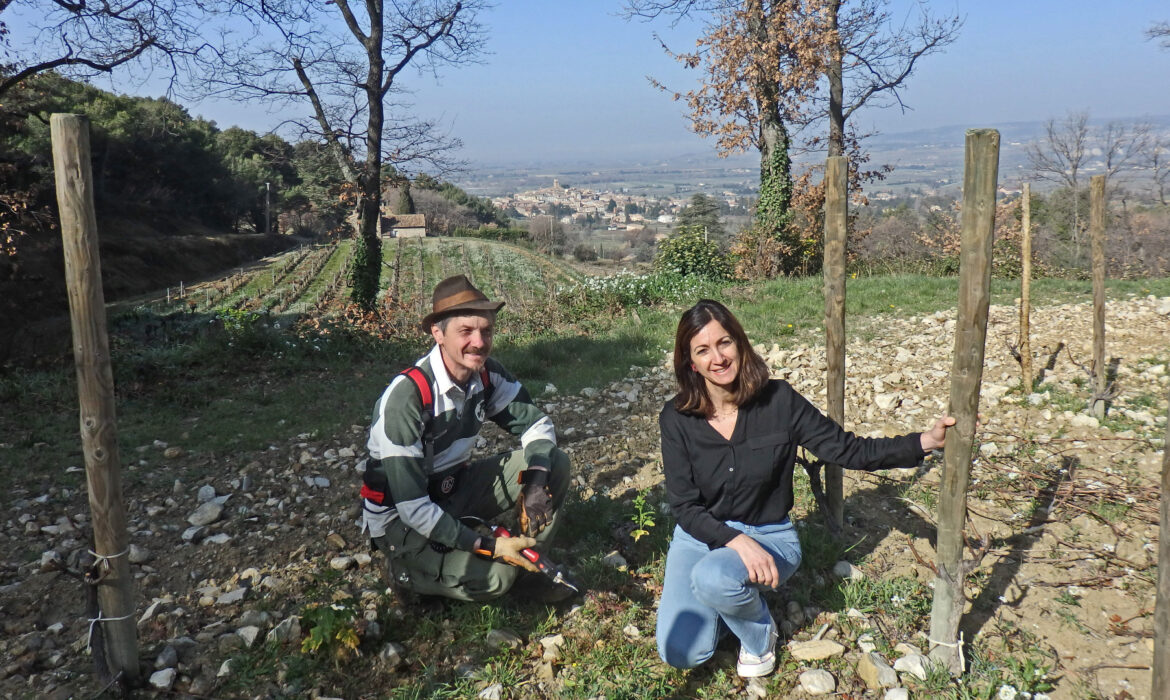
For Cheli and Jérôme Busato, based in Sablet since 2013, making and selling wine is not just a professional activity but also carries ecological and humanist values. Which they illustrated with a biblical formula, “Bonum vinum Cor Hominis Laetificat”… “Good wine gladdens the heart of man”.
Chéli Alberca and Jérôme Busato met in Andalusia on the university benches where they were pursuing their studies under the famous Erasmus programme. A couple in life and at work (she joined her husband in France in 1997), they followed diverse paths (finance-oriented business school for her, agronomy and oenology engineer for him) to finally find themselves on a shared professional project: the creation of a wine négoce house, later complemented by the acquisition of an estate.
If Chéli had had a taste for wine since her childhood in Andalusia (her father bought bulk wine every year and aged it in his small cellar, where 7 barrels were placed, one per child, each in charge of one!), the trigger for Jérôme came during a training internship at an estate in the Bordeaux region. More precisely at Château Haut-Marbuzet in Saint-Estèphe, where he met Henri Duboscq, a personality of the wine world who passed on his passion for wine to him. The direct consequence was to steer him towards viticulture and oenology studies. So there he was, launched into viticulture, drawing his wife along in his wake. A journey followed in the early 2000s that took them, among other places, through Burgundy for the Picard house and the Rhône Valley, he still for the Picard house at Grandes Serres in Châteauneuf-du-Pape, she with the Perrin family.
And then, in 2002, they decided to create their own négoce company. This was the birth of Maison Rouge, a small négoce house where everything was done at their home in Bédarrides: “Our offices were in the guest room and the tastings were done in the kitchen.” A bit cramped all the same, they later rented offices and a warehouse in Beaumes-de-Venise. And in 2013, they took another step. While remaining négociant-éleveur, they became winegrowers by buying an estate so as to finally market a few bottles of their own production. Their choice fell on Chevallon, with vines planted in the heart of the Dentelles de Montmirail massif and offices in the village centre, which was renamed to become Domaine Château Cohola, an acrostic of Cor Hominis Laetificat, which today brings together on 8 ha vines (more than half of the area), olive trees, cherry trees, beehives and truffle trees… A condensed Provence!
The new structure today markets between 30,000 and 50,000 bottles a year on the négoce side (Côtes-du-Rhône, Gigondas, Vacqueyras and Châteauneuf-du-Pape) and 10 to 12,000 organic bottles for the estate wines classified Côtes-du-Rhône Villages Sablet. For the three crus, the choice fell on an Italian bottle with a particular design; for the estate wines, the standard union bottle prevails.
“We wanted to become winegrowers to go all the way with our ideas, to be as natural as possible.” With organic labelling pushed to the extreme, as Jérôme follows the lunar calendar: “We take inspiration from biodynamics even though we are not certified.” No added sulphur in the cellar, plant-based treatments and additions of bacteria to the soils… Not to mention music: “For two years, we have trusted genodics, this science of genomes that consists, among other things, of broadcasting music in the vines. Twice a day, morning and evening, for seven minutes. It’s quite melodic.“
On the hillside terraces that Jérôme has patiently restored over the years, the Grenaches and Syrahs – which make up most of the plantings – seem to appreciate it.
IN OENOLOGICAL COMMUNION WITH CISTERCIAN MONKS, IN ISRAEL AND MADAGASCAR
Cheli and Jérôme’s journey is not limited to their professional careers. For a long time, in parallel, they have been involved in an oeno-humanist project with communities of Cistercian monks, those of the Latroun abbey in Israel (where the first vineyard was planted in 1898) and those of the Maromby monastery in Madagascar. Both share, besides their Christian faith, the practice of growing vines.
So they volunteered to play the role of consulting oenologists in this somewhat special adventure: “flying Cistercian winemakers”.
“In Israel, the harvests were earlier than here. We took our holidays in August, which allowed us to start the vinifications on site. Then, back in France, the abbot would send us the analyses and we would give instructions remotely…”
A similar scheme in Madagascar, again with a community of Trappist monks lacking oenological advice! “It was more convenient for us, the harvest taking place there in February.”
Today, the Latroun abbey is renowned for its wine; and the Maromby monastery, where grape varieties better suited to the climate had to be replanted, is following the same path. They are even building a new cellar for which Cheli and Jérôme took part in buying the tanks and equipment.
But with the development of Château Cohola, the couple has less time: “In Israel, we had a young French oenologist hired and we no longer need to travel. And in Madagascar, we brought one of the monks to our home for a year to follow courses at the Orange wine school; and today, he is our relay on site.”
Jean Calabrese
Maison Rouge Wines – Château Cohola / 415 route de Carpentras, Sablet (84110)
Tel: +33 4 90 41 81 90 / www.cohola.fr