Having moved into négoce to satisfy its customers’ demand, Clos du Caillou faces a major challenge after the acquisition early this year of Domaine de Panisse in Courthézon.
A first in the history of Clos du Caillou: the purchase, completed with the Safer during the lockdown, of the nearby Domaine de Panisse. A 13.5-ha vineyard in a single block planted in the commune of Courthézon (6.5 ha of it classified Châteauneuf-du-Pape, the rest Côtes du Rhône), which had the particularity of having no successor. This property is therefore added to the Clos’s 54 hectares of vines, 9.5 of them in the Châteauneuf-du-Pape AOP. “It is the first time since my great-grandfather created the estate in 1956 that we have expanded,” Marilou Vacheron proudly says; she has managed the property since 2016 alongside her mother Sylvie, pending the imminent arrival of her brother Axel.
The great-grandfather in question is Paul Pouizin, a winegrower from Visan looking for a farm to set up his 3rd son, Claude, then aged 20. His choice fell on this property which, at the time, comprised only a few vines, a lot of woodland and an old farmhouse. More than a wine estate, it was rather a hunting preserve surrounded by 4 km of walls (hence the name clos), belonging to the family of Elie Dussaud, mayor of Courthézon in his day. Who, as an aside, had refused to have his land assessed in 1936 at the time of the delimitation of the new Châteauneuf-du-Pape appellation… No visit from the experts, therefore, and no inclusion in the AOC for the 17 hectares enclosed in the clos! That did not stop Claude Pouizin from planting vines there for more than 40 years. In and around the now-famous Clos du Caillou. In 1995, his daughter Sylvie and her husband Jean-Denis Vacheron (from a family of Sancerre winegrowers) took over and developed the cuvées and moved upmarket.
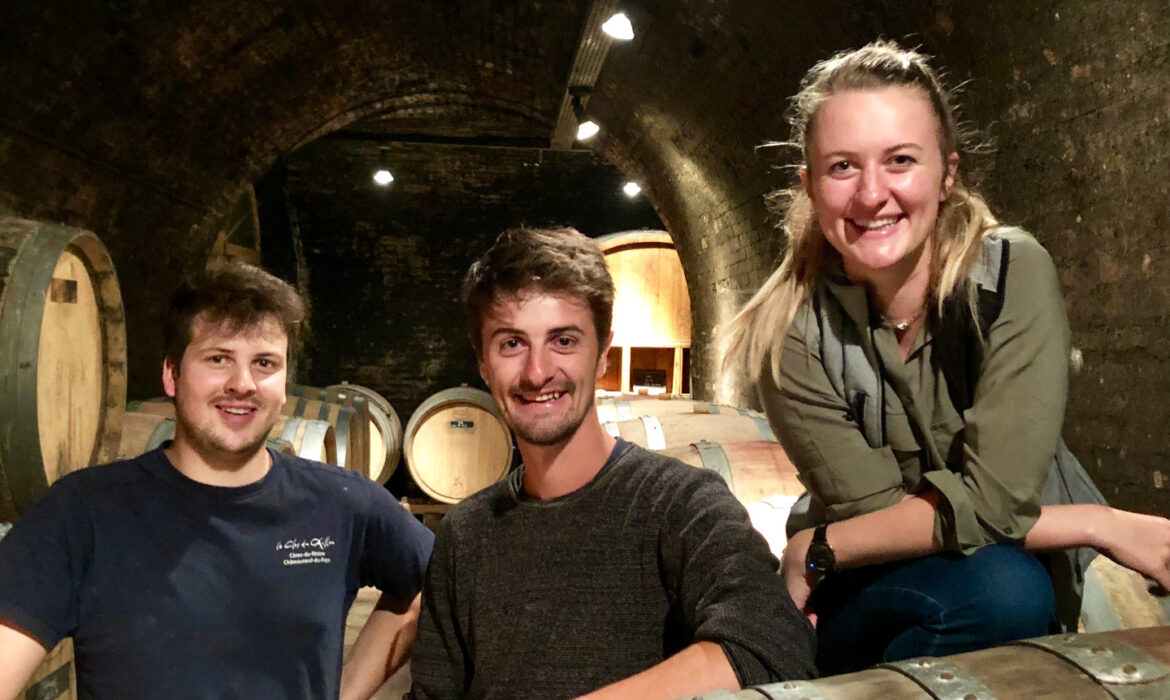
Today, the estate’s future is thus in the hands of Marilou, 27, and her brother Axel, three years younger. The former is more interested in sales, management and business strategy; the latter, currently interning with oenologist Philippe Cambie, has just earned his oenology and viticulture engineering diploma at the Changins school in Switzerland. There is also Antoine, Marilou’s partner, a winegrower in Languedoc, who arrived at the estate two years ago to support Bruno Gaspard, the talented winemaker at the helm since 2002.
“When I arrived,” adds Marilou, “we were limiting all our customers enormously because there was more demand than supply, in restaurants in particular. Hence the creation of a négoce company to at least have wine all year round.” All 17 cuvées on offer have been certified organic since 2010. Domaine de Panisse remains to be converted. A bet for the whole young team, who have given themselves until 2023 for the new-look Clos du Caillou wines all to be stamped organic or biodynamic.
Jean Calabrese
Le Clos du Caillou / 1600 Chemin Saint-Dominique, 84350 Courthézon / Tel: +33 4 90 70 73 05 / www.closducaillou.com