Since 1967, cellar groupings have followed one another in the Ardèche until the creation in 1994 of a true economic group, UVICA, which today markets more than 80% of the wines of this appellation
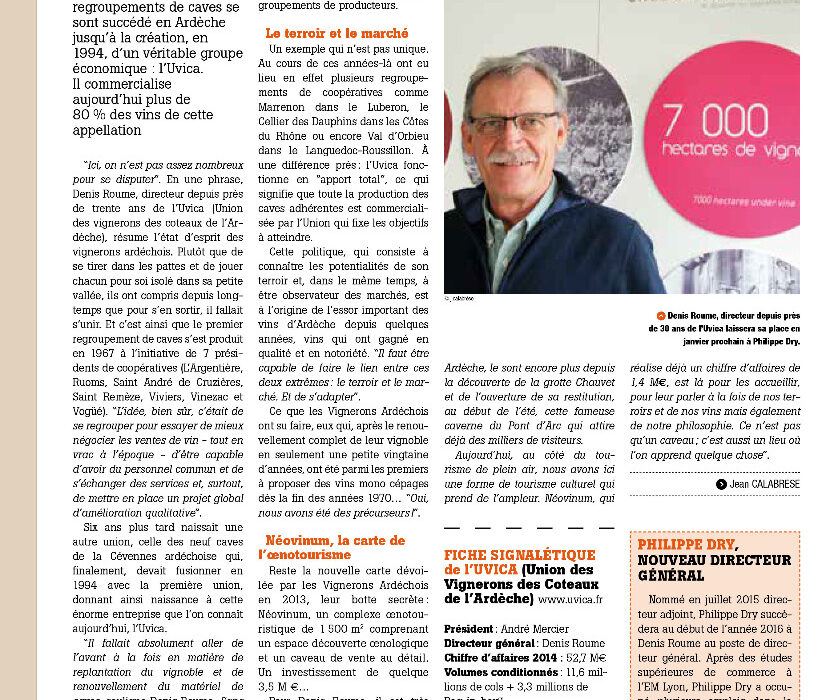
“Here, there aren’t enough of us to fight each other.” In one sentence, Denis Roume, director for nearly thirty years of UVICA (Union des vignerons des coteaux de l’Ardèche), sums up the state of mind of Ardèche winegrowers. Rather than tripping each other up and playing each for themselves, isolated in their little valley, they understood long ago that to get by they had to unite. And so the first grouping of cellars took place in 1967 on the initiative of 7 cooperative presidents (L’Argentière, Ruoms, Saint-André de Cuzières, Saint-Remèze, Viviers, Vinezac and Vogué). “The idea, of course, was to band together to try to negotiate wine sales better – all bulk at the time – to be able to have shared staff and exchange services and, above all, to set up a global project of quality improvement.“
Six years later another union was born, that of the nine cellars of the Ardèche Cévennes which finally merged in 1994 with the first union, giving birth to the huge company we know today, UVICA.
“We absolutely had to move forward both in replanting the vineyard and renewing cellar equipment,” stresses Denis Roume. “Not to mention vinification and other matters. The cooperatives wanted more grip on the downstream by offering quality products, and this ambition was fulfilled by the Union.” Even though other elements contributed a lot, such as the creation of vins de pays in the early 1970s and the implementation of the CAP which favoured producer groups.
Terroir and market
An example that is not unique. During those years several cooperative groupings took place such as Marrenon in the Luberon, Cellier des Dauphins in the Côtes du Rhône or Val d’Orbieu in Languedoc-Roussillon. With one difference: UVICA operates on “total delivery”, meaning that all the production of member cellars is marketed by the Union, which sets the objectives to be reached.
This policy, which consists of knowing the potential of one’s terroir and at the same time observing markets, is behind the significant rise of Ardèche wines in recent years, wines that have gained in quality and reputation. “You have to be able to link these two extremes: terroir and market. And adapt.“
Which the Vignerons Ardéchois knew how to do, having, after completely renewing their vineyard in only about twenty years, been among the first to offer single-variety wines from the end of the 1970s… “Yes, we were precursors!”
Neovinium, the wine-tourism card
There remains the new card unveiled by the Vignerons Ardéchois in 2013, their secret weapon: Neovinium, a 1,500 m2 wine-tourism complex including an oenological discovery area and a retail tasting cellar. An investment of some €3.5 M…
For Denis Roume, it is very important for the Vignerons Ardéchois to communicate because they are certainly in the Rhône Valley but a bit off to the side. “Yet we have always thought that selling in France and for export does not mean neglecting individuals. Especially as tourists, already very numerous in the southern Ardèche, are even more so since the discovery of the Chauvet cave and the opening of its replica at the start of summer, that famous Pont d’Arc cave which already attracts thousands of visitors.
“Today, alongside outdoor tourism, we have here a form of cultural tourism that is growing. Neovinium, which already generates €1.4 M in turnover, is there to welcome them, to tell them about our terroirs and our wines but also our philosophy. It is not just a tasting cellar; it is also a place where you learn something.”
Jean Calabrese