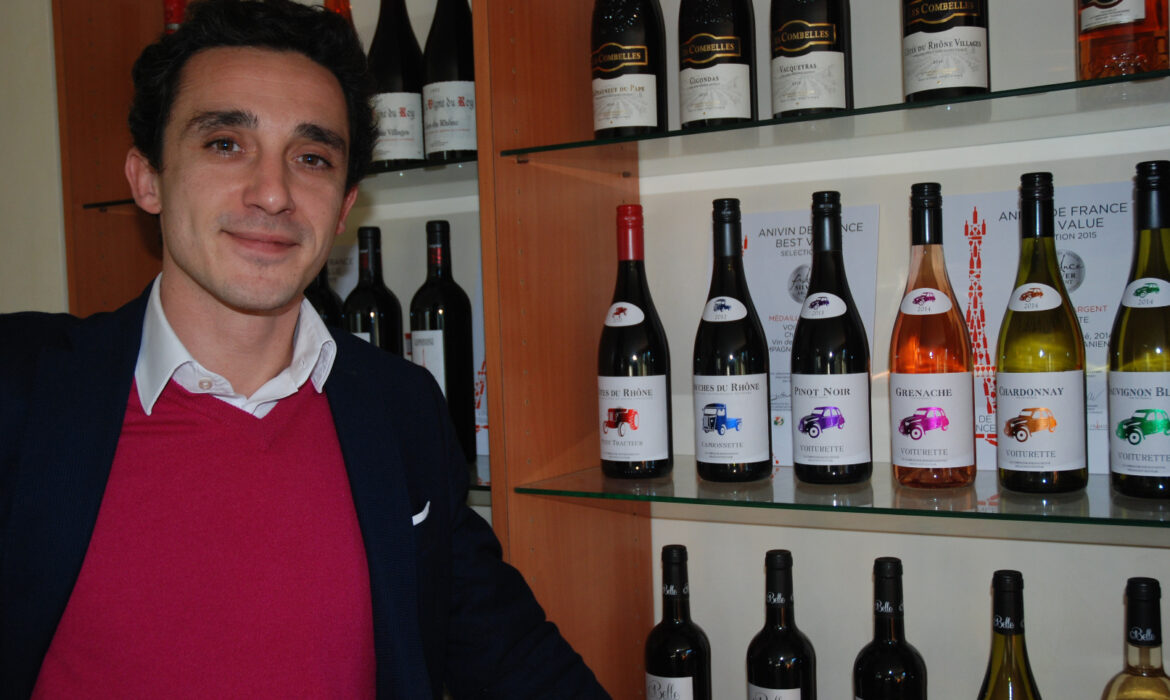
Created by and for winegrowers of the Gard as a bottling centre in 1963, La Compagnie Rhodanienne changed nature with the arrival of the Taillan group in its capital and the appointment of a new managing director, Thomas Giubbi. Who made it a recognised player in Rhône Valley négoce.
In Castillon-du-Gard, a few hundred metres as the crow flies from the famous Roman aqueduct, La Compagnie Rhodanienne shows its good health: vast premises housing the bottling lines, the tank room for ageing wines, offices for employees… Everything is spotless! But it has not always been so…
Created by and for winegrowers of the Gard (mostly cooperative cellars) in 1963, La Compagnie Rhodanienne was for a long time only a packaging centre, even after the Taillan group entered its capital in 1969. The négociant trade really appeared only in the mid-1990s when the group became the majority shareholder. As in many other structures, the focus at that time was more on a logic of volumes and turnover: an economic model that did not work. Hence the recruitment in 2011 of a new managing director, Thomas Giubbi, who found himself in a sick company losing a lot of money. Chronic and regular losses.
“The idea was therefore to reposition this company, make it structurally viable first and reposition it in core-range markets. Knowing that when I arrived, we had issues of a devalued image, with partial unemployment on the social side, a risk of the company being placed under safeguard proceedings and somewhat difficult relations with our upstream suppliers.“
In this not very easy context, it was necessary to cut into the mass: La Compagnie Rhodanienne, which employed in the 2000s some 90 people and produced 25 million bottles, has now been resized. With its 40 staff and its 10 million bottles and bag-in-box, it has regained balance.
2012, the year of repositioning
“Overall, we took everything back from A to Z: the product profiles and the whole offer,” says Thomas Giubbi. “We kept brands, restyled some, created others, the idea being to assert ourselves as a Rhône Valley specialist. And of varietal wines, particularly on the export side.”
The Sète site, which handled bulk, became independent (it is now a new entity, “Grand Sud Vins”, more oriented towards the Languedoc basin); and the less profitable markets were stopped. “In 2012, we stopped the production of two million bottles quite radically because these were lines on which we were losing money.” The organisation of work was also changed with the constant idea of improving product quality. “Our market approach was reviewed, upstream with our suppliers, downstream with our customers.” At the same time, a website was set up as well as a corporate video and winegrower videos made with partner domaines and châteaux.
“With the support of the Taillan group, we repositioned the company around this idea of being a committed winery that relies on core-range and premium segments. To respond both to the demands of the mass market (large retail, which is the heart of the company’s historic marketing) and to present a more advanced terroir offer.“
This financial recovery and the repositioning at the commercial and marketing level were carried out hand in hand. With effects already being felt. Since 2013, La Compagnie Rhodanienne has posted positive results, with continuous improvement in all economic indicators. In 2014: +23% growth in turnover; 2015 should show +15% and Thomas Giubbi expects +10% for 2016: “We have really got back onto an interesting dynamic.” Which made it possible last year to introduce profit-sharing bonuses for employees. “A great pride for a company that was sick and where there was a lot of frustration.“
A committed négoce
Thomas Giubbi proudly claims the triple commitment of La Compagnie Rhodanienne. First at industry level: the managing director of the Taillan group subsidiary wears many hats: treasurer of the UMVR (Union des Maisons de Vins du Rhône); director of Inter Rhône and Anivin (Association Nationale Interprofessionnelle des Vins de France); co-president of two appellations of the Gard: Tavel and Lirac…
Commitment also at the level of partner domaines and châteaux: “We have about twenty – some for more than 20 years – exclusively in the Rhône Valley, followed throughout the year. Our approach is to have a partner winegrower in each appellation we market, which allows us to be involved in the life of the appellation and in defending its valorisation.” And to highlight this upstream work and make these partnerships more legible, the operator has revised the dressing of some of its bottles and created a house label “Vignobles de la Compagnie Rhodanienne – Négociant Éleveur”. Alongside the essential Châteauneuf-du-Pape, Rasteau, Gigondas… La Compagnie Rhodanienne continues to widen its panel. “Since 2011 we have added a domaine in Vacqueyras, another in Plan de Dieu, two Côtes-du-Rhône, a domaine in Costières de Nîmes, and now we are working on projects in Ventoux and Beaumes-de-Venise. We also have a domaine in Tavel and one in Lirac, because we must not forget we are from the Gard.”
Finally, still on commitment, the environmental aspect, whether with partner winegrowers or at the company headquarters regarding waste management, effluents, recycling of glass, cardboard, paper…
Not forgetting control of the carbon impact: an approach begun three years ago that materialises this month of January 2016 with the launch of a new crested bottle. Produced at the O.I. glassworks site in Labégude, in the heart of the Ardèche, which is at the top of environmental standards. This lightened bottle, which brings together in its coat of arms the keys of Saint Peter, the Pont du Gard, the cross of Languedoc and the Roman jar, not forgetting the mention “La Compagnie Rhodanienne since 1963”, will weigh only 460 grams (against 600 grams for the “heavy” ones).
“Our policy is to be between tradition, with our more terroir-focused domaines and châteaux, and modernity with our varietal wines.” Varietal wines whose palette has been enriched in recent years with the launch of the “Mobiles” and “Le Petit Cochonnet” ranges. Growing in these two segments, La Compagnie Rhodanienne, which makes 2/3 of its turnover in France, mainly with large retail, its historic market, does not intend to stop there. On the national market, the company is getting ready to reach the on-trade (CHR); for export, it intends to boost sales to bring them to 50% of turnover by relying even more on the relays offered by the Taillan group with its offices in Dallas, Tokyo, Shanghai and Bangkok… USA, Japan, China: all markets already in strong growth.
Jean Calabrese
An original path
Nothing seemed to predestine Thomas Giubbi, managing director of La Compagnie Rhodanienne, for a career in the wine world. With his BTS in tourism in his pocket, he first turned to humanitarian work, working with the association “Les Enfants du Soleil” in Madagascar. “An extraordinary experience” he says, prematurely cut short because of civil war. Back in France earlier than planned, and a young father at 22, he had to take care of his little family. Drawing on his Italian roots, he landed his first job in Paris in the food industry: fresh pasta and organic products… two years of field sales experience. Before being headhunted by the winegrowers of the Beaumes-de-Venise cellar who wanted a relay in Paris. It was Alain Ignace, the President at the time, who recruited him in 2004 and he stayed with Balma Vénitia for nearly 8 years. First as on-trade salesman, then for large retail and finally as “key account” for Paris and northern France, Belgium and Luxembourg.
“I was lucky to work with a very fine cooperative cellar,” he acknowledges, “which not only allowed me to discover the wine world about which I knew practically nothing but also to follow a training course.” Thomas Giubbi was thus able to resume his studies while continuing to work, finally earning a master’s in international wine and spirits trade. After his self-taught years, he was able to validate his experience and move up a level.
To get out of the crisis for good
Considering that the barrier that once existed between négociants and producers hardly exists any more today, Thomas Giubbi, in view of the difficult decade the Rhône Valley has just lived through, makes an observation: “To get out of it lastingly, a joint steering between production and négoce houses must be put in place. In respect of dialogue and taking into account the problems specific to both families.
“This logic sometimes defended by some producers, which consists of limiting supply to push prices up, particularly irritates me. It could become counterproductive because, in the end, we disconnect from markets, from consumers’ expectations, from professionals’ needs and we lose market share. When we no longer have enough volume to feed these markets, they turn to another appellation or another producing country.”
Fact sheet
La Compagnie Rhodanienne entered the fold of the Taillan group (Merlaut family) in 1969. This group, which is in the Top 10 of French négociants, also owns – among others – the house Joseph Verdier in the Loire Valley (1965) and the house Ginestet in Bordeaux (1978), not to mention several châteaux.
Chairman: Denis Merlaut; managing director: Thomas Giubbi
2014 turnover in K€: 20,163
Commercial brands: Jean Berteau; les Combelles; les Mobiles; les Granges des Papes