Maison Bouachon earns its stripes again
Having fallen in 2001 into the hands of the Skalli group, the ancestral Maison Bouachon of Châteauneuf-du-Pape, which had gradually faded in favour of this new shareholder, is regaining its colours today under the control, this time, of the Burgundian Boisset, who wants to restore its former lustre…
Originally, Bouachon was the historic cooper of the village of Châteauneuf-du-Pape and for many estates of the Rhône Valley. In 1898, this family decided to change register and moved from the trade of cooper to that of négociant-éleveur. A smooth transition facilitated by the ties woven over the years with the winegrowers of the appellation, ties that endure today. For more than a century Maison Bouachon carefully selected parcels in Châteauneuf-du-Pape and offered fine cuvées, acquiring along the way in the 1950s cellars that allowed it to develop mastery of vinification and specialise in blending and ageing wines.
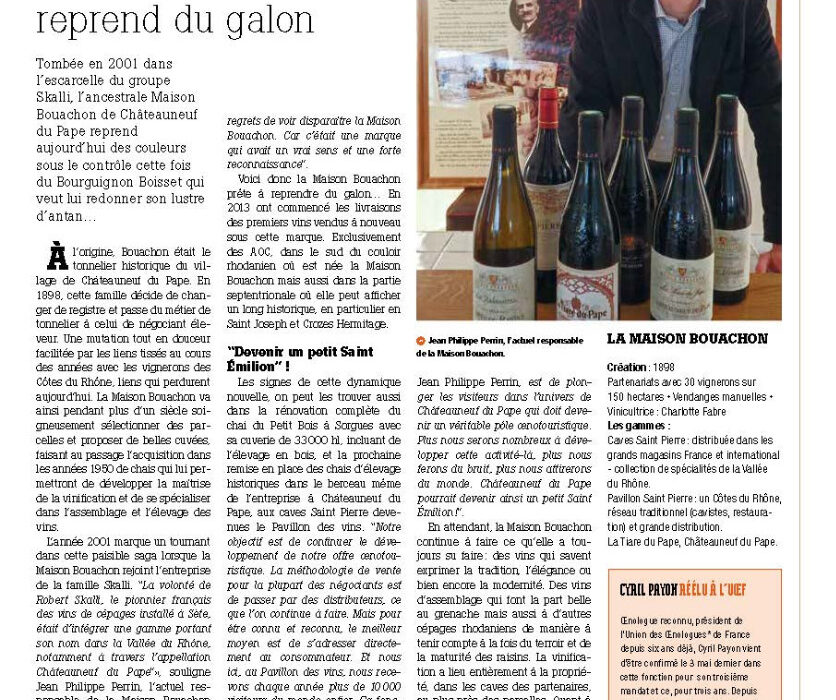
2001 marked a turning point in this peaceful saga when Maison Bouachon joined the Skalli family’s company. “The wish of Robert Skalli, the French pioneer of varietal wines based in Sète, was to integrate a range bearing his name in the Rhône Valley, notably through the Châteauneuf-du-Pape appellation,” stresses Jean-Philippe Perrin, the current head of Maison Bouachon, which in the meantime (on 23 November 2011) passed into the fold of Boisset, la Famille des Grands Vins, with almost all the assets of Skalli wines in France (Rhône Valley and Languedoc). “But unlike Robert Skalli who wanted to promote his own brand, we realised, by questioning our customers, that they regretted seeing Maison Bouachon disappear. Because it was a brand with real meaning and strong recognition among consumers.“
So here is Maison Bouachon ready to earn its stripes again… And thus in 2013 deliveries of the first wines sold again under this brand began. “Today, Skalli still exists within the Boisset group. But we no longer talk about Skalli wines: in Languedoc, we talk about Fortant, because it is the historic brand of Pays d’Oc wines, based in Sète; and as for the Rhône hub, it is Maison Bouachon that I run.“
Here, then, in the Rhône Valley, no varietal wines, no IGP. Exclusively AOCs, in the south of the Rhône corridor where Maison Bouachon was born and also in the northern part where it can claim a long history, in particular in Saint-Joseph and Crozes Hermitage.
Signs of this new dynamic can also be found in the complete renovation of the Petit Bois cellar in Sorgues with its 33,000 hl tank room, including wood ageing, and the forthcoming re-establishment of the historic ageing cellars in the very cradle of the company in Châteauneuf-du-Pape, at the Caves Saint-Pierre, now the Pavillon des vins.
“Our objective today is to continue developing our wine tourism offer here in Châteauneuf-du-Pape. The sales methodology for most négociants is to go through distributors, which we continue to do. But to be known and recognised, the best way is to address the consumer directly. And here at the Pavillon des vins, we receive more than 10,000 visitors from around the world each year. It works extremely well.“
That is why the whole place is going to be given a makeover, outside and inside, to make it more attractive. And it is Frédéric Didier, chief architect of historic monuments at the Château de Versailles, who already rehabilitated the Chartreuse de Bonpas in Caumont, another property of the Boisset family, who will lead operations.
“Today, in the Rhône Valley, there are estates here and there across the vineyard and some cooperative cellars offering activities but everything is sparse. The idea,” adds Jean-Philippe Perrin, “is to immerse visitors in the universe of Châteauneuf-du-Pape, which must become a true wine-tourism hub. The more of us develop this activity, the more noise we make, the more people we attract. Châteauneuf-du-Pape could thus become a little Saint-Émilion!”
In the meantime, Maison Bouachon continues to do what it has always known how to do: wines that express tradition, elegance or even modernity. Blended wines that, as it should be, give pride of place to Grenache but also to other Rhône grape varieties so as to take account of both terroir and the ripeness of the grapes. Vinification takes place entirely on the property, that is, in the partners’ cellars, closest to the plots. As for ageing, if it is done in enamelled steel and stainless steel tanks for freshness, it is in oak barrels or demi-muids that one finds the historic know-how of Maison Bouachon, with an ageing duration that varies with wines and vintages but is always between 8 and 16 months…
Jean Calabrese