In Ampuis, the wine-tourism facility that has just opened its doors brings together in its tasting area all the productions of Maison Guigal, Maison Vidal-Fleury, Domaine de Bonserine and Château de Nalys… But there is also a museum, a pop-up gastronomic space and seminar rooms.
The luckiest – locals and visitors to the Ampuis wine market – had the chance to visit it in January while the works were not quite finished. “We opened a bit with forceps because we weren’t quite ready, but we couldn’t miss this opportunity to show off this new wine-tourism space that is so close to our hearts.” So says Philippe Guigal, who recalls the genesis of this creation, which had germinated in his father Marcel’s mind decades ago, when the Guigals became owners of the Vidal-Fleury establishments and, at the same time, of this fine building that now serves as the setting for the Caveau du Château. That was in the 1980s… But in the meantime, the family had other priorities, the latest being the acquisition of Château de Nalys in Châteauneuf-du-Pape, which positions the family business in the southern part of the Rhône Valley.
THE DISCOVERY OF CLOS JOLY / Two years ago, then, father and son told each other: “We’re ready!” All the more so as, with the rise of wine tourism, the planets were perfectly aligned… Setting aside the easy solution of putting this tasting room within the Château d’Ampuis itself, owned by the Guigals since 1995, their choice fell on Clos Joly: a fine 19th-century building flanked by a magnificent park, located 300 metres as the crow flies from the château, on the village’s main road used every day by some 15,000 vehicles… interesting when you also want to attract passers-by.
The final project is quite far from the initial one: as there was no land for the car park, it had at first been considered to chainsaw all the trees in the park to create one… A heartbreak made all the more painful by the fact that a young man named Etienne Guigal had planted them in the last century when he worked at Vidal-Fleury… Whereas on the other side of the building there was nothing, just a plot in joint ownership that the Guigal family was finally able to acquire. The park was therefore preserved, as was the building, in which nothing was changed in the structure apart from the entrance, which was added for practical reasons.
THE TREASURE ROOM / Today, the wine lover who arrives in the tasting room will be immediately seduced by the harmony of the place, expressed through the materials chosen in connection with the winegrower’s trade: stone for the floors; oak wood to recall the barrels in which the wines are aged; glass in which they are bottled. “We also needed a structuring element for the whole, and we chose bronze, patinated bronze, which allowed us to create other elements such as the lift shaft.” Once this first tasting room is taken in, the wine lover will be irresistibly drawn to the “treasure room“, as Philippe Guigal likes to call it. This room is smaller, cooler, more exciting… For gathered here are the greatest wines of the Guigal company, created, it should be recalled, on 1 January 1946. To begin with, the great white wines of Maison Guigal; there, the best Châteauneuf-du-Pape cuvées from Château de Nalys; next to them, the northern icons of Maison Guigal, the great Côte-Rôties but also Hermitages and Saint-Josephs; and a little further on (turning clockwise), the flagships of Maison Vidal-Fleury and Domaine de Bonserine, which are also in Côte-Rôtie. In the end, a quite exceptional panel of Great Wines (La Mouline, La Turque, La Landonne, La Doriane and many others…) that can also be tasted.
A PLACE OF WELCOME AND SHARING / “We offer different types of tastings,” explains Marielle Grossetête, the manager of this new venue. Starting with welcome tastings, held at the counter for a friendly, no-frills tasting. Without a reservation, visitors can taste several wines by choosing the category: discovery of the most accessible appellations such as Crozes-Hermitage and Saint-Joseph in the northern Rhône Valley, and Cairanne and Gigondas in the southern Rhône Valley, or a selection of more prestigious appellations such as Hermitage, Côte-Rôtie, Cornas, Châteauneuf-du-Pape… Each time, the customer can choose the number of wines and the appellations they wish to taste: 3, 4, 5 or 6 wines; there is even a 10-wine package. On the first level, it is 3 wines for 9 euros; at the 2nd level: 3 wines for around 15 euros.
“But there are also themed tastings where everything is completely adjustable. Terroir focus, comparisons between the different houses… We can do anything as long as we have the wines. We make suggestions but we don’t want to lock the customer into pre-established schemes. Here, everything is possible.“
When talking about terroirs, for example, it is possible to do tastings on the same vintage of 100% Côte Blonde, a blend of Côte Brune and Côte Blonde, or 100% Côte Brune: “Things that are better understood when expressed in the mouth.“
Jean Calabrese
Le Caveau du Château is located at 6 route de la Roche – 69420 Ampuis. Besides its tasting room and museum trail, it offers a service to businesses for events with seminar rooms and a suitable wine-and-food space with a customised professional kitchen. It is also possible to visit the cellars and discovery trails in the vines. www.lecaveauduchateau.com
contact@lecaveauduchateau.com
//////////////////////////////////////////////////////////////////////////////////////
A museum of the vine and Gallo-Roman arts
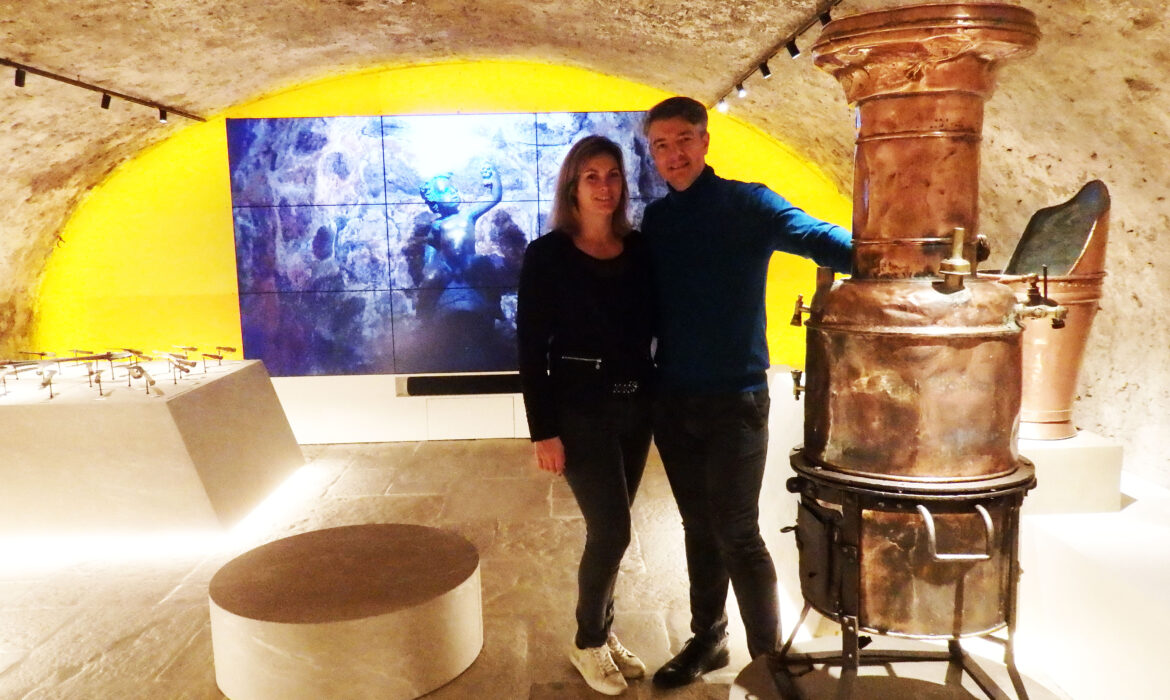
In the basement of the Caveau du Château, a museum. Which you can visit or not, depending on your mood. With a first room dedicated to viticulture and all those tools that still allow vines to be worked today: pickaxes, heel billhooks, bigots, grafting knives; there is also a series of objects relating to oenology, cooperage and many other things, including a magnificent foudre carved with the attributes of the Passion of Christ… a rare piece: “My father and I have always been interested in vine and wine tools and in cooperage.” But not only… For the Guigals also have a passion for Gallo-Roman culture. For 40 years, they stored; with the Caveau du Château, they can exhibit.
Thus, with the help of the Vienne-Condrieu tourist office and the scientific backing of the Saint-Romain-en-Gal museum, they reveal to visitors some of their finest pieces out of the 700 catalogued. With, of course, a series of amphorae: Italic, Phoenician, Massaliote and even African ones of the 4th century… found in the gardens of Château d’Ampuis during its restoration! And coins: precisely 172 meticulously selected from the 480 in the family collection, set in a wave-shaped Plexiglas partition.
It was Eve Guigal, Philippe’s wife, who supervised the setting up of these collections, following the advice of various scenographers and museographers. With, amid all these historic pieces, a nod to contemporary art in the form of an original work by the Belgian artistic duo Arianna Musetta and Marcin Sobolev, created especially for the museum.