Pierre Amadieu, négoce the winegrower’s way
The famous Gigondas House, which built its reputation on its vineyard, fully intends to keep its family and artisanal fibre
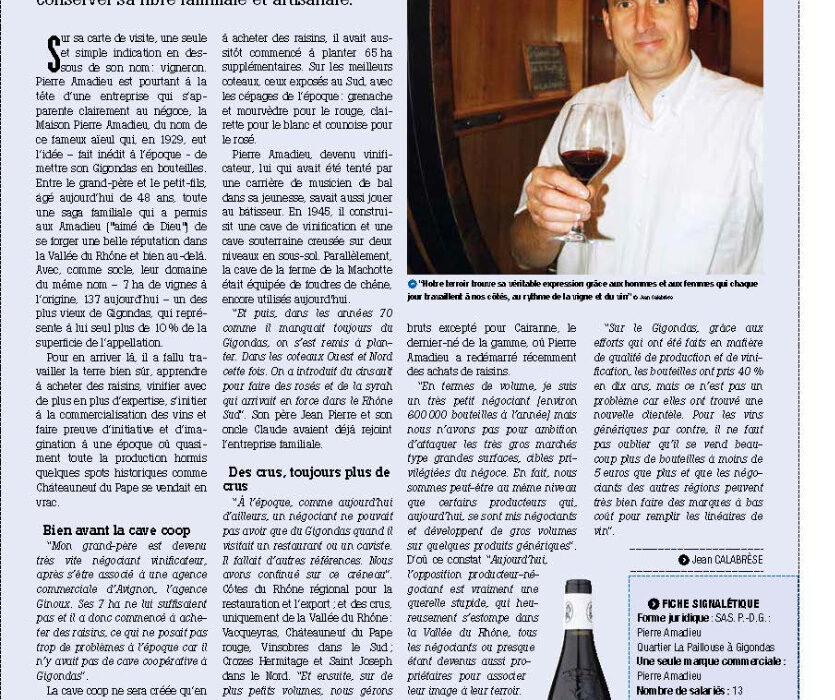
On his business card, a single simple indication beneath his name: winegrower. Pierre Amadieu nonetheless heads a company that clearly resembles négoce, Maison Pierre Amadieu, named after the famous forebear who, in 1929, had the idea – unheard of at the time – of bottling his Gigondas. Between grandfather and grandson, now 48, a whole family saga that allowed the Amadieus (“loved by God”) to forge a fine reputation in the Rhône Valley and well beyond. With, as a foundation, their domaine of the same name – 7 ha of vines originally, 137 today – one of the oldest in Gigondas, which alone represents more than 10% of the appellation’s surface.
To get there, it took working the land of course, learning to buy grapes, vinifying with ever more expertise, learning to market wines and showing initiative and imagination at a time when almost all production, apart from a few historic spots like Châteauneuf-du-Pape, was sold in bulk.
Well before the co-op cellar
“My grandfather quickly became a négociant-vinifier, after partnering with an Avignon commercial agency, the Ginoux agency. His 7 ha were not enough for him so he started buying grapes, which wasn’t too much of a problem at the time because there was no cooperative cellar in Gigondas.”
The co-op cellar would only be created in 1956. A date that coincides with the start of production on the new lands the grandfather had acquired four years earlier, those of two historically linked domaines, Grand Romane and La Machotte: 400 ha of woods and mixed farming in a narrow valley high up in the Dentelles de Montmirail. And while continuing to buy grapes, he immediately began planting an additional 65 ha. On the best slopes, those facing south, with the grape varieties of the time: Grenache and Mourvèdre for red, Clairette for white and Counoise for rosé.
Pierre Amadieu, having become a vinifier, he who in his youth had been tempted by a career as a dance-band musician, also knew how to be a builder. In 1945, he built a vinification cellar and an underground cellar dug on two levels. At the same time, the cellar of the La Machotte farm was equipped with oak foudres, still used today.
“And then, in the 70s, as there was always a lack of Gigondas, we started planting again. On the west and north slopes this time. We introduced Cinsault for rosés and Syrah, which was arriving in force in the southern Rhône.” His father Jean-Pierre and his uncle Claude had already joined the family business.
Crus, ever more crus
“At the time, as today moreover, a négociant could not have only Gigondas when visiting a restaurant or wine merchant. Other references were needed. We continued in that niche.” Regional Côtes-du-Rhône for restaurants and export; and crus, only from the Rhône Valley: Vacqueyras, red Châteauneuf-du-Pape, Vinsobres in the south; Crozes Hermitage and Saint-Joseph in the north. “And then, in smaller volumes, we manage more fragile or slightly more premium appellations that we buy directly in bottles (the winegrower’s cuvée with our label): Muscat de Beaumes-de-Venise, Tavel, Côte rôtie, Condrieu and Cornas.” With a constant on these bottle sales: 50% come from production; 50% from négoce with purchases of raw wines except for Cairanne, the latest addition to the range, where Pierre Amadieu has recently restarted grape purchases.
“In terms of volume, I am a very small négociant [about 600,000 bottles a year] but we have no ambition to attack the very big markets such as supermarkets, the privileged targets of négoce. In fact, we are perhaps at the same level as some producers who have now become négociants and who develop large volumes on a few generic products.”
Hence this observation from Pierre Amadieu: “The producer-négociant opposition today is really a stupid quarrel, which fortunately is fading in the Rhône Valley, almost all négociants having also become owners to associate their image with their terroir. This idea of ‘the négociant is the baddie who takes my margin’ has become obsolete even if tensions can appear at times of wine crisis.” Which often concern only regional Côtes-du-Rhône…
“On Gigondas, thanks to the efforts made in production quality and vinification, bottles have risen 40% in ten years, but that’s not a problem because they have found a new clientele. For generic wines, however, we must not forget that far more bottles are sold under 5 euros than above and that négociants in other regions can very well make low-cost brands to fill wine shelves.“
Jean CALABRESE