What some would never have imagined, Samuel Montgermont has done: transposing the concept of the Burgundian clos to Châteauneuf-du-Pape, at Grandes Serres!
Samuel Montgermont, managing director of Maison Grandes Serres in Châteauneuf-du-Pape, after other projects such as the partnership with the Cave de Cairanne, has thrown himself into this new adventure without inhibition. Since Michel and Gabriel Picard, at the head of the prestigious family company Picard, a Burgundian house based in Chassagne-Montrachet, entrusted him with developing the “Rhône division” of their wine group, Samuel Montgermont has been making the most of everything. The mission order dates from 2010. Today, this house has reached maturity. Within a perimeter the MD defined at the start: to be a specialist in the southern Rhône Valley with privileged work in what he calls the golden triangle: Châteauneuf-du-Pape, Gigondas, Cairanne. “It is our area of activity,” he stresses. “Our geographical identity. I never wanted Grandes Serres to be a jack-of-all-trades house… except for Ventoux, where I have friends and which is close to my heart as a cyclist.” He climbed it 17 times last year, in fact!
The Cairanne bet won
When Samuel Montgermont left Château La Gardine to take over Grandes Serres, it was the smallest entity of the Picard family. “Above all, a foundation had to be built,” he states. Which he did patiently and tenaciously. For, as a good Breton, he has consistency in his ideas. Hence a series of investments and partnerships, the most important being the one concluded at the end of 2013 with the Cairanne cooperative cellar, then under a drastic recovery plan. Provision of the winery, acquisition of the bottling line, management of the Victor Delauze supermarket brand…
“Quite a few people said you couldn’t marry a négociant and a cooperative. Today, seven years later, we still get along perfectly well. For a simple reason: we respected each other’s know-how.” The cellar, led by Denis Crespo, positioned itself in the traditional sector with its own brands and export network; the négociant-winemaker oriented itself more towards supermarkets and large-scale export… “It is indeed a pooled site as far as production, vinification, storage and packaging are concerned. For the rest, we respected each party’s wishes. With total transparency on the prices I pay on their bulk.” A bulk to which Grandes Serres has priority access, particularly for Cairanne wines, the cellar vinifying almost 5,000 hl in this appellation, a little more today following the merger with the Cécilia-Chantecôtes cellar of Sainte-Cécile-les-Vignes. “The cooperative members live autonomously; and I vinify my own Côtes du Rhône and Villages, Gigondas too, with grapes I buy from other winegrowers.” A partnership without a contract: “I didn’t want one. I am a lawyer by training, specialised in wine law. And I always say that in a contract, what you plan for is the exit. Until then, we live perfectly well, with respect for one another.“
The Clos Saint Patrice adventure
In 2014 began the negotiations – formalised in 2015 by a proper partnership – with the Julian family, Jérôme the son and Guy, the father now deceased. The Julians, owners of 28 ha in Châteauneuf-du-Pape and about a dozen ha in Côtes du Rhône, sold all their production in bulk. They were looking for a new partner…
“I discovered their wines and was left stunned in front of two barrels that Guy Julian calls Saint Patrice, coming from a 1.8-hectare plot bought in 2009. Planted with old Grenache and Mourvèdre, it sits in the heart of the historic terroir, on the Avenue Impériale in Châteauneuf-du-Pape. The other wines he offered me were also very good – but they didn’t have that exceptional grain and finesse…“
Samuel Montgermont then decided to start research on this plot. He asked Mr Julian for his notarial deed, consulted not only the land register but also several 18th- and 19th-century works, including the 1838 Vaucluse directory, which ranks this famous plot as a “grand cru”! He tracked down the historic owners, the Jourdan family. “Marcel Guigal, when he was a kid, remembers coming to taste in this cellar.” He is not the only one to know of the existence of this cru: Michel Bettane, also a fine historian, wrote an editorial in 2015 in his magazine En Magnum entitled “Where did Clos Saint Patrice go?”; and James Joyce, the famous Irish poet and writer, who swore only by white wine, used to serve just one red to his guests, this same Clos Saint Patrice… That was in the 1930s.
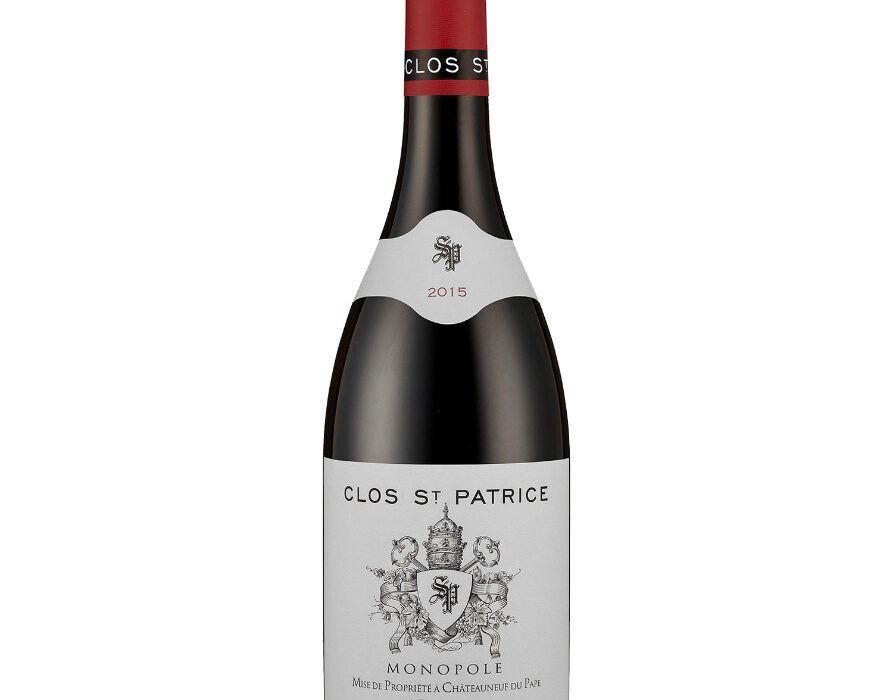
The head of Grandes Serres therefore convinced the Julians to revive this historic cru. So, alongside Domaine Saint Patrice, which produces some 25,000 bottles, they brought back Clos Saint Patrice: 6,000 bottles in the best years, sold at €110. To do so, all the administrative hassles had to be overcome to create a monopole, the first in the Rhône Valley if Château Grillet is excepted: an entity in its own right within the Châteauneuf-du-Pape appellation, registered in the land register and delimited by a stone wall. “My idea, and I make no secret of it, is to create a hierarchy within the appellation,” stresses the MD of Grandes Serres, who considers that across the 3,200 ha of the Châteauneuf-du-Pape vineyard, not all wines are at the same level. “And since you can’t speak of grand cru Châteauneuf-du-Pape, or even premier cru, the monopole box is a subliminal box for this notion. A bit like in Burgundy.“
Jean Calabrese
Samuel Montgermont at Clos Saint Patrice. The original building, with an unrivalled view of the famous plot and of Châteauneuf-du-Pape, has been entirely restored. It will soon house Saint Patrice “Le lieu”, where Music, Contemporary Art, Gastronomy and Tasting will be in the spotlight.
//////////////////////////////////////////////////////////////////////////////////////////////////////
Ten years to build a solid foundation
Over the past decade, Samuel Montgermont has worked to build a solid foundation for the various entities he supervises. First Maison Grandes Serres, which has become a full-fledged négociant-winemaker with annual production of about 7 million bottles. From Côtes-du-Rhône Villages to Châteauneuf-du-Pape via Cairanne, Gigondas and Vacqueyras.
Then the Cairanne site, which, with the arrival of Chantecôtes and the activity of Grandes Serres, could quickly become a major organic winemaking hub of the southern Rhône Valley. The sum of the three represents about 45,000 hl, a production already largely organic and, for the reds, sulphite-free.
The Saint Patrice estate already mentioned. The partnership with the Varenne family in Gigondas (nearly 15 ha of vineyards), where there is also an extension of Grandes Serres, a “research and development” cellar where trials are made around terroirs, grape varieties, ageing wines in amphora without sulphites, Clairette de Bulle…
And finally Maison Denuzière* in Condrieu, another property of the Picard family. “With Caroline Moro, who supervises the site, we gave it back a commercial strategy and a real northern Rhône Valley positioning.” “Today, Caroline expresses herself fully in this house and she is recognised both internationally and in the French press. J. Denuzière now enjoys a very fine reputation…“
As will be understood: with all his projects, Samuel Montgermont has no time to idle. “It has been ten years now that I have been running Grandes Serres. I took the time to build a solid foundation, and if I was able to do so, it is solely thanks to the trust of the roughly 120 growers who buy into my projects. Real loyalty… without any contract!“
* See Le Vigneron, December 2020.
KEY FACTS
Les Grandes Serres, négociant-winemaker, 430 Chemin de l’Islon Saint Luc, Châteauneuf-du-Pape.
Locations: Châteauneuf-du-Pape (head office), Gigondas (Grandes Serres la Boutique), Cairanne (les Grandes Serres) and Condrieu (Maison Denuzière).
President: Gabriel Picard; managing director: Samuel Montgermont; assistant director: Caroline Moro
Contact: +33 4 90 83 72 22 / http://www.saintpatrice.com