By going from 25 million bottles to 9 in 15 years, Vignobles & Compagnie has returned to profit. Turning its back on a volume model, the Castillon-du-Gard company, historic négociant-bottler for the winegrowers of the Gard, has reoriented towards quality. With audacity and success…
Committed négociant & winegrower
A winegrower, Vignobles & Compagnie has been since 2017 and the lease of Château des Sources and a neighbouring property: 50 hectares planted and 20 to replant in Costières de Nîmes. The winery has made commitment to winegrowers its credo and the foundation of its positioning. When you follow, sometimes for more than 25 years, about twenty domaines, it creates bonds… “One of the company’s fights,” says Thomas Giubbi, its managing director since the end of 2011, “is to ensure the continuity of the farms. In four domaines, the children have taken over. It is possible because they have worked with us for a long time, have good visibility and can live decently from the product of the vine.”
Vineyard base
Today, the winery’s vineyard base has taken over. The strategic shift towards quality required reviewing all wine profiles and thus the methodologies, which rest on supporting partner winegrowers, from vine management to vinification. Soil work, pruning, replanting, choice of grape varieties and rootstocks, harvest routes to obtain the desired ripeness in terms of acidity, alcohol and aromatic intensity, choice of yeasts, duration of maturation… this constant involvement answers a strong demand from winegrowers and consumers. “A shared commitment in the service of the wines the customer expects, respecting terroirs,” sums up Thomas.
Economic steering
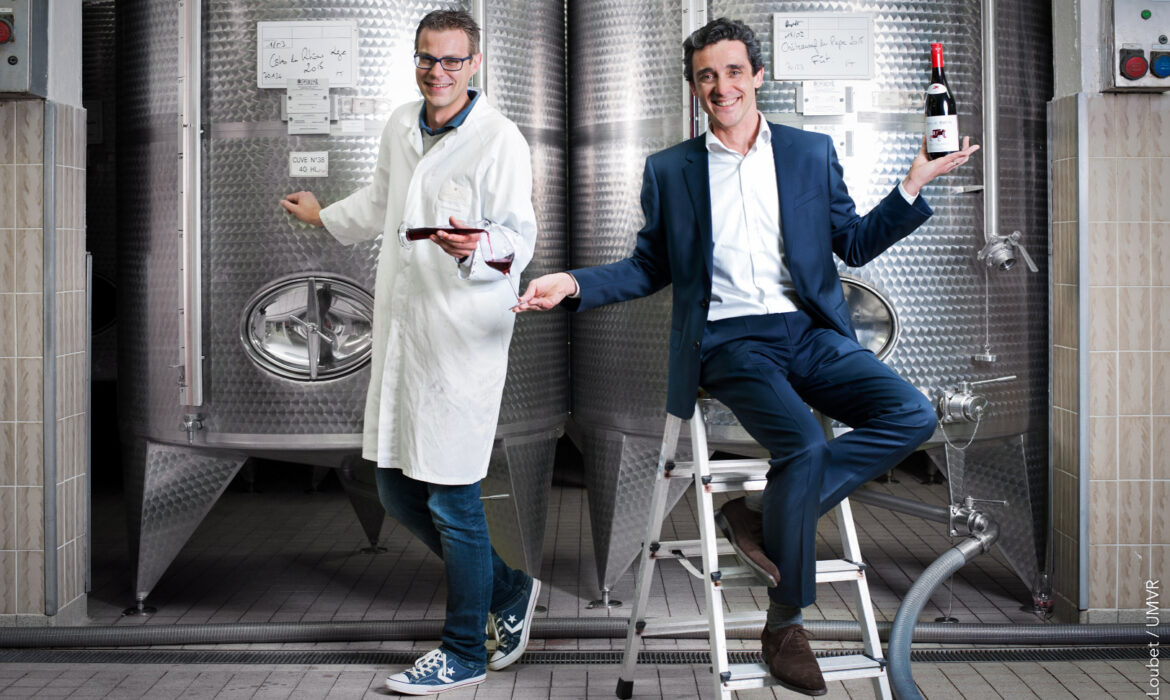
Commitment is also what Thomas Giubbi does when he sits on the UMVR board, co-chairs the Lirac and Tavel appellations, and serves as director of Anivin and Inter-Rhône. This allows him to advance priority fights such as economic steering of the sector. The challenge is to have a fine analysis of markets in order to anticipate and manage better. This implies setting up reliable indicators and agreeing with producers to make the right decisions. “The 2016 harvest,” says Thomas, “is one of the weakest historically for varietal wines. But as prices had previously jumped a little too hard, we broke the toy. Despite an extremely low harvest in volume, we are in over-production, because the markets have reoriented, including French large retail, towards Spain, Chile, etc.”
Rhône winery
The UMVR decided to present its négoce companies under the term wineries du Rhône, gallicising this word that designates a place where wine is made, but also where one develops one’s marketing and sales.
Even if the union’s most traditional houses sometimes have a few reservations about using an Anglo-Saxon term, the word winery has the merit of being understood everywhere. And above all, everyone finds themselves in the need to claim and assert here, collectively, the pride of a trade that creates value for all. “The difference between the Rhône wineries and those of Mendoza, for example, is plural,” explains Thomas Giubbi. “It is a strong entrepreneurial spirit, in an important historical environment, with a much stricter regulatory universe. And then a history of PDOs and terroirs, those of the Rhône Valley, much more present than in other regions of the world. All while cultivating this spirit, this sometimes offbeat tone: being serious without taking oneself seriously.”