Samuel Montgermont
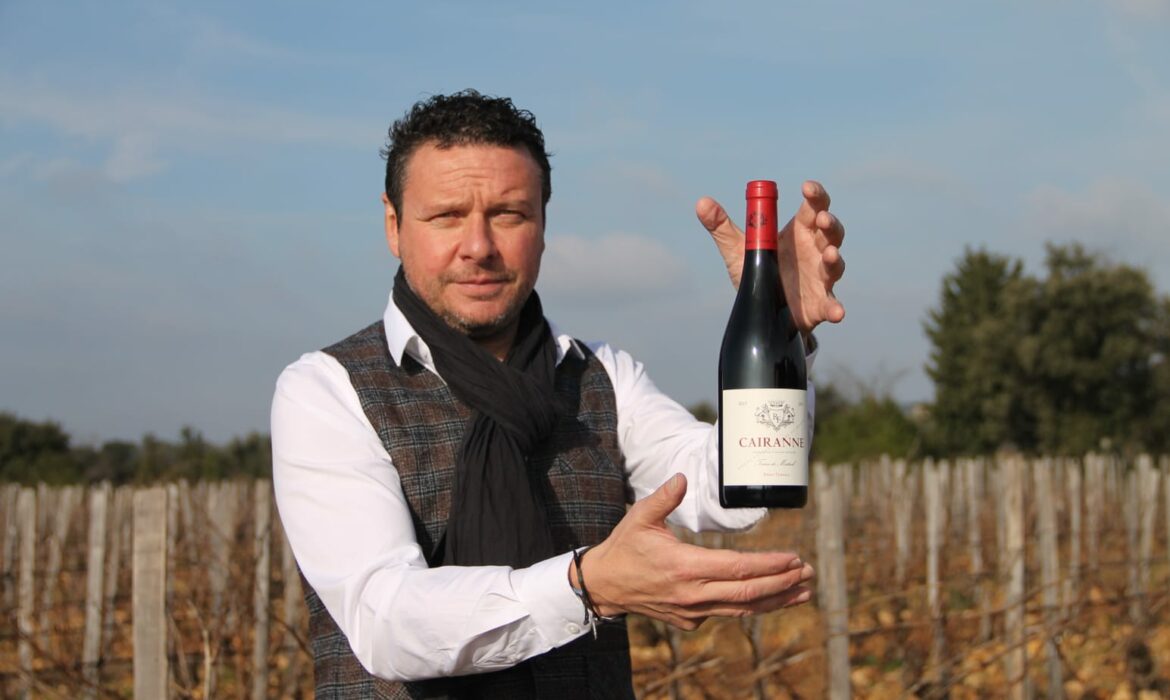
The managing director of Grandes Serres and Maison Denuzière, two subsidiaries of the prestigious family company Michel Picard in Burgundy, is now at the head of the trade association of Rhône Valley négociants. Elected on 5 March, Samuel Montgermont, vice-president of the UMVR since 2014, succeeds Etienne Maffre. In his speech, the new president did not fail to pay tribute to his predecessor’s work: “It is a matter, while staying the course, of redoubling our efforts in a health, economic, political and legislative context officially unfavourable to the flourishing of our companies.” Redoubling efforts is precisely one of the strong points of the new president of the Rhône basin’s négociants’ association. Nothing can dent Samuel Montgermont’s enthusiasm. Whether in the vines or on his bike on the slopes of Mont Ventoux, this hard worker, a rocker in his spare time, has a definite taste for difficulty.
Moving the lines
The election of Samuel Montgermont, a personality with an atypical career who claims the trade of artisan-négociant, is a sign of the Rhône wine houses’ will to firm up the outlines of their profession. “Our vocation is to be involved at every stage of making a wine, upstream and downstream, from the vine to the cellar, from defining a marketing strategy to selling.” Being a négociant in the Rhône basin means being a winegrower for almost all of the UMVR’s 70 members. It most often means being a winemaker, taking risks by buying grapes and transforming the raw material. For the new UMVR president, it is not enough to say it to be naturally part of the landscape. You have to take action, build tangible bridges between the vine and négoce, and move the lines.
Building partnerships
The future of the sector and the improvement in the quality of Rhône basin wines also depend on the evolution of the négociant-winegrower relationship. The win-win partnership initiated in 2013 by Samuel Montgermont between Grandes Serres and the Cave de Cairanne – then under a drastic recovery plan – is a fine example of the virtuous effect of pooling efforts, skills and the working tool.
The cooperative continues its activity while Grandes Serres vinifies and bottles its harvest supplies in Cairanne. For many, a marriage between a négociant and a cooperative was impossible. Their moral contract, based on transparency, trust, the distribution of roles and the principles of sustainable development, celebrated its seventh anniversary in 2020. Cairanne is in a way the laboratory of the field of possibilities upstream and downstream of the vines on the southern slope of the Rhône Valley.
Asking the right question is already answering it
France, still the number one market for Rhône basin wines, is experiencing a wave of falling consumption that is violent and faster than expected. The CREDOC speaks of a 60% drop over the next 10 years. “Yesterday, it was about drinking less but drinking better. Today, drinking less is better.” Without defeatism, Samuel Montgermont is certain that you cannot fight structural changes and the rise of policies demonising alcohol and wine. On the other hand, it is possible to accompany, even anticipate, the evolution of trends if wine players integrate sociological indicators into their strategic thinking. “Asking the right questions is already answering them. By understanding and accompanying the evolution of society and consumption patterns, by working together, Rhône Valley winegrowers and négociants will be able to anticipate demand and make tailor-made wines adapted to the reality of markets in France and export, in supermarkets or in wine shops.” Samuel Montgermont warned UMVR members that he had not drawn up a strict programme but wished to share with them a vision of the wine world… A vision that heralds a full agenda and passionate exchanges.
The Union des Maisons de Vins du Rhône is:
70 négociants, 90% of which are SMEs
65% certified organic
1,752 employees
More than €1 billion in turnover, 33% of it from export
327 million bottles marketed in Rhône Valley AOP or IGP, representing 48% of the region’s total AOP wine marketing
SAMUEL MONTGERMONT, PASSIONATELY AN ARTISAN-NÉGOCIANT
Samuel Montgermont came to the wine world by chance. A happy chance. A jurist, he studied in Rennes and specialised in wine and vine law. That was not enough to feed his curiosity. He also wanted to learn how to make wine. He headed to the south of France for training in Suze-la-Rousse and a first winemaking internship at Domaine des Béates in Lambesc. The property then belonged to Michel Chapoutier. Following his stay in the Coteaux d’Aix, this stubborn Breton, passionately in love with the vine, joined Château de la Gardine in Châteauneuf-du-Pape. He is loyal. He stayed there ten years before meeting Michel and Gabriel Picard, who gave him carte blanche to spread the wings of Grandes Serres on the southern slope of the Rhône basin and later of Maison Denuzière on the hills of Condrieu. Samuel Montgermont wants to create a solid foundation, and works at it successfully, showing an openly declared preference for a golden triangle formed by Châteauneuf-du-Pape, Gigondas and Cairanne.
It is moreover with the Cairanne cellar, then under court-ordered recovery, that he made his mark and moved the lines, by putting in place in 2013 an agreement to pool the production site. “A win-win partnership inspired by the principles of sustainable development: the cooperative members live in perfect autonomy and I vinify my own Côtes du Rhône, my Villages and Gigondas too, with grapes I buy from other winegrowers.”
This atypical négociant, who rightly claims the know-how of an artisan-négociant, also has a sure palate. In 2014, he met the Jullian family, owners of 28 hectares in Châteauneuf-du-Pape. “They sold all their wine in bulk and were looking for a new partner. One day, I was left speechless in front of two barrels that Guy Jullian presented to me as the Saint-Patrice, a 1.8-hectare plot planted with old Grenache and Mourvèdre in the heart of the historic Châteauneuf-du-Pape terroir. The other wines were also very good but they did not have that exceptional grain and finesse.” Samuel Montgermont began research, consulted the land register and several 18th- and 19th-century works, and discovered that the 1838 Vaucluse directory classified this plot as a Grand Cru. A real moment of happiness. Samuel Montgermont managed to convince the Jullians and to foil the administrative and legal constraints by creating a monopole. Yet another first in the Rhône Valley, with the exception of Château Grillet, which has a status quite apart. No more than 6,000 bottles of Clos Saint-Patrice are sold each year.
This does not stop the head of Grandes Serres from stating: “There is nothing more galvanising than blending a wine intended for supermarkets with the same care as a micro-cuvée but on volumes of 100,000 bottles, and coming first in a blind tasting.”
Samuel MONTGERMONT is a passionate man. When he is not devoting himself to wine, he returns to his first loves, the guitar and rock. A musician and singer, he is currently working on his second album, accompanied by his faithful Telecaster, the mythical guitar of Bruce Springsteen. And to challenge himself, never give up, and go all the way in his commitment, Samuel climbs on his racing bike to regularly tackle the famous ascent of Mont Ventoux.