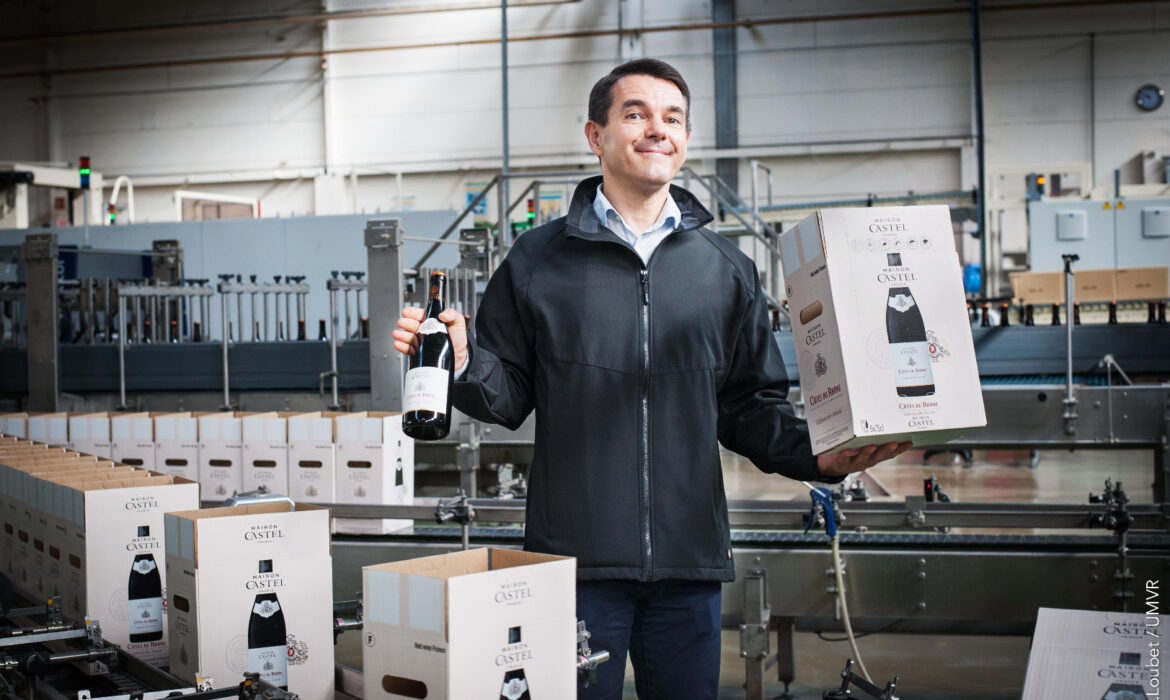
Christophe Chagnot runs the Saint-Priest site for the Castel Group. A site that marks the interest of France’s leading négociant group in the Rhône Valley and the export potential of its wines.
Fifteen million euros have been invested in the St Priest site since the takeover of Selles and the bringing together of Castel’s Rhône activities at the gates of Lyon. The aim is to continue, while accelerating it, the Group’s roots in a region where it does not yet have the market share it has elsewhere. The result on the equipment side is a flexibility that allows it to handle more than fifty different bottles, as many as on all its other bottling lines combined. And on the strategy side, a complete reorientation of the foundations of the négociant trade. “Previously,” explains Christophe Chagnot, “our supplies were mainly sourced via bulk buyers. Today, we source our needs as close to production as possible, with the private cellar as a priority. Our role as a négociant, our core business, is to be the link between consumer expectations and production.”
The Rhône, a development axis
If the Castel Group has identified the Rhône as a strong development axis, it is for several reasons. First, the importance of the PDO, the second in France after Bordeaux. Then because the wines of the valley easily find their audiences in all markets, blending with all cuisines and showcasing their organoleptic qualities. Not forgetting that, in a region swept by the mistral, the need for inputs is lower, which meets a growing expectation from retailers and consumers. The Castel Group, owner of 2,500 hectares of vines, 1,000 of them in France, does not yet have an estate in the Rhône Valley. But it is looking carefully at the opportunities that might arise, particularly in Côtes du Rhône Villages such as Plan de Dieu, where it is very active, or in an appellation such as Châteauneuf-du-Pape, able to give it a prestigious showcase.
Developing exports to prepare for the future
The St Priest site currently makes 30% of its sales outside France and would like to bring this share to 50%. The reasons: positions that are already very strong in France; retailers such as Carrefour or Intermarché investing in their own tools; and per-capita consumption that has stabilised at around 40 litres of wine per person per year and will not rise again.
The Castel Group is mainly positioned in emerging countries. “In Cambodia, Vietnam, China or Russia, people live the Western way,” comments Christophe. “Wine is a marker of development. Even if our positions are weakened, French wine remains the reference. In China, our leading export market, the French wine consumer has done better than others, or has better taste than others.” In the most mature markets, such as England, competition is fierce. Countries such as Chile see in Brexit an opportunity to gain market share.
With the fall of the pound sterling, French wines became 20% more expensive. Retailers reacted immediately: ranges were adjusted downwards to compensate for the price rise. For entry-level products, French wines were replaced by wines of other origins, often Chilean. That is why, says Christophe, “even if we must remain present in these markets, we also have to diversify and aim at emerging markets to prepare for the future.”
The UMVR for balance
In his view, the UMVR must find the right balance in its investments in order to defend the interests of both production and négoce, making sure that the allocation of budgets takes real trade into account. “The temptation is great to concentrate investment on the premium end, because you tell yourself that the more expensive the product, the more support it needs,” he says. “But you have to be careful to remain visible to the mass market.” In the many emerging consumer markets, the number of customers to win over is enormous.
And in all these countries, the wines of the Rhône Valley are popular. “The region is magnificent,” observes Christophe. “It brings together everything foreigners love: ancient monuments, landscapes, the art of living. We must play on that by stressing the thread that unites us. And from Vienne to Avignon, that thread is the Rhône.”